- Weapons Catalog –
(
I have done my best to recreate the original formatting)
(
The photo links did not work, so I deleted them. If anyone has good images for the described items, please let me know or send me a link to your image hosting site and I can add them)
(Written by Sur Vanar Utírieste March 18, 2012)
Link to original thread
(
The following images and photographs are property of their respective owners and artists. Information has been obtained from various sources...)
Types of Swords
Arming Sword - often referred to as a “knightly sword”. It is the standard blade given to members of the Lindon Guard. Wielded with one hand, allowing for the use of a shield on the other hand.
Backsword - Favorite sidearm of the infantry, characterized by having a single cutting edge and a flat “false edge”, which may be sharpened to facilitate thrusting attacks. Fitted with a knuckle guard, it is often worn slung around the waist or tied to the saddle of a horse.
Broadsword - Basket-hilted, with a substantial two-edged blade used to cut rather than stab primarily. Capable of cutting off the limbs or head of an enemy in one fell stroke!
Claymore - Two-handed weapon, particularly effective and feared due to its large size but light weight. Quicker and more effective than other swords requiring the use of both hands, the section above the handle is often wrapped or covered.
Cutlass - Short slashing sword, with a straight or slightly curved blade, and a sharp cutting edge. It is a common naval weapon, often featuring a hilt with a solid cupped or basket-shaped guard.
Falchion - One-handed single-edged sword, with the combined weight and power of an axe, and the versatility of a sword.
Flambard - Undulating flame or wave-like edges, contribute to this distinguishing blade. While it is largely decorative, it is quite useful in combat.
Katana - Curved, slender, single-edged blade, with a circular or squared guard and long grip to accommodate the use of two hands. Quickly drawn and suited for combat depending upon a fast response, capable of striking down an enemy in one motion.
Longsword - also known as “hand-and-a-half sword” and “bastard sword”, though the term itself is ambiguous. Straight, double-edged, consisting of a grip that provides enough room for two hands, though it may also be wielded with a single hand as well. All parts, including the pommel and cross-guard, are used for offensive purposes such as hewing, slicing, and stabbing.
Panabras - Consisting of a single cutting edge curving forward, narrowest near the hilt, and dramatically thicker near the tip. Large, may be held with one or two hands, delivering deep butchering chopping and thrusting motions. (
Rapier - Sharply pointed sword with a slender blade, providing protection for the hand wielding it. Ideally used for thrusting attacks, may cut to some degree but not to that of wider heavier swords. While specific hilts may vary, a fat pommel provides balance for the long blade.
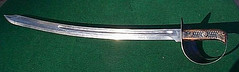
Sabre - Usually curved, single-edged, with a rather large hand guard covering the knuckles as well as the thumb and forefinger. Mounted warriors often carry it in a scabbard hanging from a shoulder belt, or waist-mounted sword belt.
Scimitar - Curved blade used in horse warfare because of its relatively light weight compared to that of larger swords. Good for slashing opponents while riding on a horse, and beheading enemies.
Side-Sword - Functioned mainly as a weapon for civilians, it is also used by warriors to some degree. In the hands of a skilled sword-wielder it can prove very effective for handling a mix of armored and unarmored opponents, dispatching enemies, and responsive to quick changes.
Smallsword - also referred to as a “court sword” or “dress sword”. Light one-handed weapon, designed for thrusting, typically with a “shell” type guard.
Spadroon - Light, straight blade for cutting and thrusting, often with a beaded or “five-ball” hilt. Popular among seafaring warriors, it is single-edged or double-edged.
Spatha - Straight and long, broad and powerful, used by mounted warriors and infantry members.
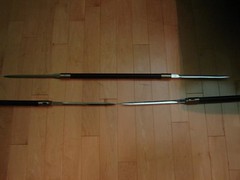
Twin Hook Swords - Thick, unsharpened, with prongs or hooks near the tips. Often used in pairs, to trap and deflect other weapons, slash opponents, and block incoming strikes.
Daggers and Knives
Baselard - Fast, light, and capable of both cuts and effective thrusts. It is a large dagger, with an H-shaped hilt.
Cinquedea - Primarily used as a thrusting weapon, it is a well-balanced double-edged blade, tapering sharply to a point. Could defend civilians and warriors against enemy swords, pass for a dagger, and be carried around in cities, at court, while traveling on horseback, or on a hunt.
Dirk - Long, thrusting dagger for hand-to-hand combat. Used by warriors, naval officers, and occasionally a ceremonial weapon.
Ear Dagger - Consisting of a distinctive pommel, not unlike the human ear, it is a relatively rare and exotic dagger. With a single sharp cutting edge, and ending in an acute point.
Golok - Broad, cleaver-like cutting knife, often used for bush and branch cutting, and easy to sharpen.
Grosse Messer - also known as a “great knife” or “war knife”. It is a stout wide blade, featuring a generously-sized handle, and could be wielded with one or two hands. Used to protect against the ravages of brigands, cutthroats, and outlaws, because it is capable of shearing through mail armor or cutting a man in half with a single strike!
Katara - Short, wide, lightweight, triangular blade. Distinguished by its H-shaped hand grip made of two parallel bars connected by two or more cross-pieces, and thickened point that prevents it from bending or breaking. Capable of piercing textile, mail, and even plate armor!
Machete - Ultimate outdoor and survival tool, that makes a truly deadly weapon. May be used to cut, chop, slash, hack, split, scrape, scoop, hammer, dig, crush, carve, crack, smash, gut, filet, skin, and butcher about anything. Rugged enough to resist every sort of damage, it is a hair-shaving sharp blade that can last practically forever.
Misericorde - Narrow, long knife, used to deliver the final stroke of death upon a mortally wounded enemy. Thin enough to drive through the gaps between armor plates, against an opponent’s face, and pierce the heart of a foe.
Poniard - Acutely-pointed blade, lightweight and long, used for thrusting and as a backup weapon on the battlefield.
Push Dagger - Popular close-combat weapon, for civilians as well as warriors. Short-bladed, with a T-shaped handle, protruding from between the fingers when properly gripped in the hand of its wielder.
Rondel - Principally designed for stabbing and cutting, it is a weapon ideal for puncturing mail armor. Diamond or triangular-shaped blade, with a cylindrical handle made of wood or bone, and a sharpened point.
Sais - Pointed dagger-shaped metal batons, with prong-like side guards, which are usually symmetrical. Generally, used in pairs for rapidly striking, trapping, and blocking attackers from all directions.
Scissor - Hardened steel tube, with a capped off hand end consisting of semicircular blade, encasing the wearer’s entire forearm. Deadly and versatile, though a bit strange, used to block an opponent’s blows and counterattack with savage slashes.
Seax - General purpose weapon, with a long broad blade, suitable for all sorts of camp work, shipboard, or fighting. Etched on both sides, capable of taking a razor-sharp edge, and consisting of a long grip that allows for two-handed use. Tied onto a waist belt, it is used in the event in which a shield or primary weapon is lost to the warrior.
Sickle - Hand-held agricultural tool with a curved blade, typically used for harvesting grain crops but also used as a weapon. Consisting of either smooth or serrated edges, mainly for the purpose of cutting, whatever or whoever it may be.
Stiletto - Long slender blade, with a narrow cross-section and needle-like point to penetrate deeply. Intended primarily for stabbing, not designed for cutting or slashing.
Sword-Breaker - Sturdy blade featuring slots on one side resembling the teeth of a comb, capable of standing up to substantial forces, catching an opponent’s sword, holding it fast, and breaking it.
Trident Dagger - Designed so that a portion of the blade springs outwards on each side, trapping the weapon of an assailant and dispatching them with the other hand.
Blunt Weapons
Aklys - Equipped with spikes, and attached to one arm of the wielder by a strap of adjustable length, which enables the weapon to be retrieved after being hurled and snapped at an enemy.
Brass Knuckles - called “knuckles”, “brass knucks”, or even “knucklesdusters”. Pieces of metal, despite their name, shaped to fit around a warrior’s knuckles with an extended or rounded palm grip.
Crowbar - Metal bar, generally consisting of a small fissure and a single curved end. Commonly used as a lever to pry open objects, remove nails, and break things; also serving as a weapon capable of creating wounds a knife can’t.
Cudgel - also known as “singlestick”. Carried by civilians and used to train soldiers in swordplay, substituting an actual blade, for a stout wooden stick. Functions as a walking staff and as well as a weapon for both self-defense and war.
Flail - Jointed armor-fighting weapon, featuring one or more spiked or knobbed steel heads, attached by chains or hinges to a short wooden handle. Versatile, suitable for close-contact fighting, striking with tremendous force when struck against the protective covering of a foe.
Flanged Mace - Strong, heavy, with a head consisting of protruding symmetric edges of stone, copper, bronze, iron, or steel; it is capable of denting and penetrating armor with a single blow and reducing the effectiveness of a warrior’s shield.
Jutte - May have a small spear tip or blade attached to the handle and hidden in the rod shaft. Captures enemy swords, hooks onto clothing or parts of the body, and penetrates the joints of an assailant. Allows for the use of different techniques, such as punches and strikes to large muscle groups, and may be used in pairs.
Kanabō - Constructed out of hefty wood or iron, featuring spikes or studs along a round or multifaceted shaft, and a slender handle.
Knobkierrie - Good for throwing at animals in hunting or clubbing an enemy’s head, often ornately carved with faces or shapes that have symbolic meaning. Serves as an excellent walking-stick in times of peace, but may be wielded as a weapon in a moment’s notice.
Mere - Short leaf-shaped club, featuring two smooth sides and a broad rounded apex narrowing to form a handle. Featuring a wrist cord to prevent the weapon from slipping during thrusting and jabbing.
Morning Star - Resembling a mace, usually with small spikes around the particle of the head. Characterized by a wooden shaft, long two-handed form, reinforced at the top with an iron band, and wielded by both infantry and calvary.
Pickaxe Handle - Unofficially used as a weapon, without the perpendicular head attached. It is quite strong and heavy, made of wood or metal, and used to jab (not swing).
Sally Rod - Long thin wooden stick, generally made from willow and used chiefly as a disciplinary implement. Also used like a club, without the fencing-like technique of stick fighting in fights and brawls.
Shillelagh - also called a “loaded stick”. It is traditionally made from blackthorn wood or oak, hollowed at the heavy “hitting” end and filled with molten lead to increase its current weight. Used for parrying, striking, and disarming an attacker.
Slapjack - Flat profile outer skin, containing a hard weight material within, and a long strap that allows for a flail-type swing at any part of an opponent’s body to inflict injury. Crafted of various materials, the preferred being leather for the outside and lead for the inside.
Sledgehammer - Though not intended to be wielded as a weapon, it is nevertheless, capable of generating enough force to cave in a man’s skull when swung fully. Consisting of a large flat head, typically made of metal, can apply more force than other hammers due to its abundant size.
Tonfas - Single-handle batons made customarily from red oak and handled in pairs, gripped by the short perpendicular handle or by the longer main shaft. To catch and stop the blunt or sharp weapon of an aggressor, strike a blow in return, or break objects.
Waddy - referred to also as a “hunting stick”. Curved and short hardwood club, could be painted if desired, and feature a stone head attached. This curious weapon is capable of splitting shields, stunning, and killing prey and assailants alike.
War Hammer - Versatile close-combat weapon, made up of a head and a handle, not unlike a hammer. Often featuring a spiked side that could grapple and pierce the heaviest armor. May also be used to bash an assailant’s head in with a strike to the helmet, and knocking riders off their horse to fight them more easily off their steed.
Spears, Axes, and Polearms
Battle Axe - Lightweight axe intended specifically for combat, consisting of a narrow slicing blade, and wielded with one or two hands (depending on the size). Capable of severing the limbs of an enemy, and very well suited for repeated strikes against an adversary.
Broadaxe - Flat large-headed axe, featuring a broad and curved blade, which is also thick and sturdy. Intended solely to kill, and wielded with one hand.
Dane Axe - Characterized by a thin blade, superb for cutting, which can be thrown if needed and is quite handy in close combat, with or without a shield.
Double-Voulge - occasionally called a “pole cleaver”. Made up of blades bound two-thirds of the way in the both ends of a broad shaft, and intended for hacking opponents.
Glaive - Single-edged blade on the end of a pole, with an affixed blade in socket-shaft configuration similar to an axe head and used to pierce or slice through flesh as needed. Variations with a small hook or spike on the reverse side are known as “glaive-guisarmes”.
Halberd - called “halbard” or “halberd”. Two-handed shaft topped with an axe blade, always with a hook or thorn on the back portion of the spike head. Quite versatile, it is used for grappling mounted enemies and blocking adversary weapons, and particularly effective against plate armor plus reducing the effectiveness of a shield.
Harpoon - Elongated spear-like instrument used to catch fish or large marine mammals such as whales. Impales the animal in target, allowing the fishermen to use a rope or chain attached to the butt of the projectile to catch it, but may be also wielded as a weapon.
Javelin - Constructed first and foremost, for casting as a lightweight ranged weapon, by hand without the use of a mechanism. An effective hunting weapon as well, additional throwing straps increase standoff power and aid in taking down large game.
Lance - Long, heavy, spear-like weapon made of wood. Designed to be used by a mounted warrior to catch and hold on to the shield of an opponent, as well as throw an adversary off of his or her horse. Featuring a steel or iron metal tip, and recognized as the weapon of jousting tournaments.
Pike - Very long thrusting spear, varying considerably in size, with an iron or steel head affixed. Used extensively by members of the infantry for aggressive attacks to stop incoming mounted enemies and charging opponents on foot. Not intended to be thrown.
Pollaxe - Polearm consisting of a wooden handle and a mounted steel head, widely used by members of the infantry. Can be used to piece plate armor, hack down an enemy as well as trip, block, disarm, and slice him or her.
Quarterstaff - also referred to as a “short staff” or simply “staff”. Traditional pole weapon, consisting of a long and thick hardwood shaft, sometimes reinforced with metal tips. Used in close combat to thrust, sweep, club, or even strike opponents in regions unprotected.
Shepherd's Axe - Long and thin light axe with a metal butt, serves as a walking stick and combat weapon, wielded in a hammer-like fashion.
Spear - Pole weapon consisting of a shaft, usually made of wood, with a pointed head that may simply be the sharpened end of the shaft itself. Used for hunting or combat, featuring additional barbs or serrated edges in its apex, some may be designed for thrusting and some throwing.
Spontoon - Extremely long weapon featuring an elaborate head, often with a pair of smaller blades on each side, and used as a primary weapon of foot soldiers, but also as a signaling tool.
Swordstaff - Made by placing a blade at the end of a staff, thus getting the same benefits of a sword with the range of spear or polearm. Helps fight enemies both on foot and mounted, while the blade is still handy enough to use in close combat as opposed to a spear.
Trident - also called a “trishul”, “leister”, or “gig”. Three-pronged spear used for fishing and combat, prized for its long reach and ability to trap other long-weapons between its prongs to disarm their wielder. Trident users may also cast a net to wrap their adversaries first, and finish them off with the trident. Please note, this is not a pitchfork!
War Scythe - Improvised pole weapon, created from a standard scythe by extending it upright from the shaft and forming an infantry weapon both practical in offensive and defensive actions against a mounted enemy. Characterized by its long range, powerful force due to leverage, and slashing or stabbing attacks.
Ranged Weapons
Arbalest - also referred to as an “arblast”. Large weapon with a steel prod, not unlike a crossbow, but larger and capable of greater force.
Bolas - Throwing weapon consisting of weights on the ends of interconnected cords, designed to be swung and then released to capture enemies by entangling their legs. Featuring two or three heavy balls, but capable of up to eight or nine.
Boomerang - Flying rotating wing curved and usually flat, crafted of wood or bone. Used a weapon or for sport, its uses vary abundantly, capable of killing small game such as birds and rabbits when used for hunting.
Cable-backed Bow - Bow reinforced with a cable made from animal, vegetable, or synthetic fibers on the back. Tightened to increase the strength of the bow, and thus, relieve tension stress from the back of even a bow made of the poorest-quality wood.
Catapult - Device used to throw or hurl projectiles a great distance without the aid of explosive devices. One of the most effective mechanisms during warfare, and though it is not used typically by the Lindon Guard, remains ever a key siege weapon against fortifications.
Composite Bow - Bow made from horn, wood, and sinew laminated together. Provides shape and dimensional stability, all while storing energy, and convenient for a warrior on foot or horseback.
Crossbow - Bow mounted on a stock for shooting bolts and other projectiles, consisting of a mechanism in which the bow string is drawn, playing a significant role in battle, but also used for shooting sports and hunting.
Darts/Blowgun - Needles used as projectiles, which can be coated in homemade poison for effective killing and hunting, and fired with the aid of a small tube known as a blowgun, also called a “blowpipe” or “blow tube” that uses the force of a warrior’s breath.
Flatbow - Relatively wide bow, narrow and becoming deeper at the rounded non-bending handle, which is for made easier to grip. Featuring flat, wide, non-recurved limbs, approximately rectangular in cross-section, this bow is usually made of wood.
Laminated Bow - Particularly strong bow, in which different materials such as wood and fiberglass are coated together, to form the stave of the bow itself. Not to be confused with the composite bow!
Longbow - Tall bow, roughly equal to the height of the user, allowing for a fairly long draw, at least to the jaw. Used for hunting and warfare, not significantly recurved, and consisting of relatively narrow limbs. Lighter, quicker to shoot and more quietly than other bows, but not as fast and accurate.
Recurve Bow - Bow featuring tips curving away from the user, a string that touches a section of the limb, giving greater amount of energy and speed to its arrows. A very good choice for beginning archers though preferred generally by warriors of all levels, for environments of brush and forest terrain, or while on horseback, since longer weapons may be burdensome.
Reflex Bow - Bow with arms curving or curling away from the archer throughout their length, resembling a “C” when unstrung. Long variations of this weapon may be more difficult to string and reverse themselves suddenly, which is why a reflex bow is seldom used for hunting, but shorter variations ideal for horseback use.
Self Bow - Fairly straight bow made from a single piece of wood, approximately the height of the archer, and less efficient in the specialized art of flight archery.
Sling - Projectile weapon typically used to throw stones or lead “bullets”, placed on a small cradle or pouch in the middle of its two cords. Swung, its projectile is released with a flick of the user’s wrist at the precise moment.
Straight Bow - Weapon crafted of all natural materials, completely straight despite its minor curves. Simple in design compared to other hunting bows, but requiring more skill to use, hence it is wielded by only the most experienced archers who can aim and shoot quickly.
Throwing Axes - Missile weapons thrown in an overhand motion, in a manner that causes them to rotate as they travel through the air before penetrating the target.
Throwing Knives - Missile weapons that require accuracy, calculation, and a sufficient amount of force to be effective. May be thrown in a variety of spin or no-spin techniques, allowing for great accuracy and range.
Throwing Stars - Hand-held sharp concealed weapons, generally used for throwing and sometimes stabbing or even slashing. Taking many shapes and designs, and not primarily intended to kill but rather to support a warrior’s main weapon, as a nuisance or distraction.
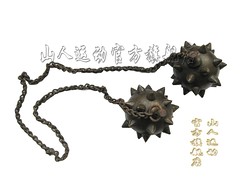
Meteor Hammer - often referred to simply as a “meteor”. It is a weapon of flexible construction, featuring either one or two weights connected by a rope or chain. Wielded by its user for defensive and offensive purposes, true masters can unlock its full potential, and do almost anything with it.