


What kind of fairytales and folklore might have been around in Middle-earth, given that Elves and Dwarves are very real peoples, for example? Would it have been along the lines of the rumoured walking trees that some Hobbits spoke of?
This sort of came to my mind after thinking how closely Glorfindel translates to Goldilocks (Glorfinniel perhaps as a feminine form…?) and what story might have been told about Glorfindel and the Three Beorns…
Fairy Tales In Middle Earth
- Points: 2 417

Arien
Posts: 1982
Joined: Thu May 07, 2020 8:56 pm
cave anserem
- Points: 4 777

Tree
Posts: 3136
Joined: Sun May 17, 2020 7:54 pm
Tis a good question, and I'd rather be reading answers than giving one. I hope some better will come. But I feel that it goes back to the Ents, or at least theirs are the folktales I'd most like to hear but can hardly imagine. But then that is me, with my prejudices against the other free peoples of Middle-earth, which go like this:
Elves only tell stories about Elves, and sometimes tell their stories about Elves to others. (They are navel-gazers).
Dwarves only tell stories about Dwarves, and never tell their stories to others. (Those will be deep, dark stones, only to be looked into with due care and consideration.)
In Gondor we hear more Elvish stories, with some bitter history of their own thrown in.
- For the problem is, I think the question touches the weak spot of Elves, at least, who might be able to make Rings of Power and Seeing Stones, a sub-creative art beyond us, but in imagination are actually a bit deficient compared to mortals (though to think i would ever dare to say so in this place!)
We must go to Rohan to hear any real folktales and fairy-stories, told of Elves, Ents, and Hobbits (those would be good to hear more of!)
Hobbits tell the best fairy-stories, and wrote some of them down - but there be many more Hobbit lads and lasses who ran off into the blue and had adventures...
As a matter of fact, the best stories in the Shire are told by Farmer Maggot. He heard them from Bombadil, who knows them from Goldberry.
Elves only tell stories about Elves, and sometimes tell their stories about Elves to others. (They are navel-gazers).
Dwarves only tell stories about Dwarves, and never tell their stories to others. (Those will be deep, dark stones, only to be looked into with due care and consideration.)
In Gondor we hear more Elvish stories, with some bitter history of their own thrown in.
- For the problem is, I think the question touches the weak spot of Elves, at least, who might be able to make Rings of Power and Seeing Stones, a sub-creative art beyond us, but in imagination are actually a bit deficient compared to mortals (though to think i would ever dare to say so in this place!)
We must go to Rohan to hear any real folktales and fairy-stories, told of Elves, Ents, and Hobbits (those would be good to hear more of!)
Hobbits tell the best fairy-stories, and wrote some of them down - but there be many more Hobbit lads and lasses who ran off into the blue and had adventures...
As a matter of fact, the best stories in the Shire are told by Farmer Maggot. He heard them from Bombadil, who knows them from Goldberry.
Eat earth. Dig deep. Drink water.
- Points: 4 777
Tree
Posts: 3136
Joined: Sun May 17, 2020 7:54 pm
Now you have me started on introducing fairy-stories and Hobbit fantasy into the Guide to Stairs! I have to be careful to keep the Guide separate from the realms of fan-fiction, as it is an objective investigation of canon (in the making). But i have an outline forming for what would be only my second fan-fiction story, set in the 4th Age when a batty descendant of Sam and Rosie, after spending a lonely youth with distant relatives in Undertowers, where for some reason there were no cousins to play with and so Fredegar Gamgee until way past his tweens had been lost in the Red Book, still housed in a forgotten corner of a hole under the tallest of the towers but otherwise forgotten by the Hobbits of the day... Anyway, after some subsequent misadventures, when he finally comes into his own as heir of Bag-end of Hobbiton, Fredegar uses the last wealth hidden in the tunnels of the comfortable hole to build, next to the ancient tree that still stands on the top of the Hill, an even taller tower - to disastrous consequences!
Eat earth. Dig deep. Drink water.
- Points: 2 817

New Soul
Posts: 3091
Joined: Thu Sep 02, 2021 6:24 am
Chrys: You got prejudices against other free peoples? You wouldn't say...  I feel you indeed on a right track to argue that an elf would only tell tales about themselves and share them among his kind. But I feel it depends strongly under what sorts of economical, political and social circumstances a group of people live, that their tales are adapted in that retrospect. He wouldn't write a tale of an heroic enemy, if that is not desired.
Silky: Aye, as Chrys said it is a good question and invokes me thinking too about it. I have been wondering about that myself, as there is not that very much on fairytales inside Middle Earth. Tolkien did wrote various poems on Elves, which are more ballades to me, if you can say this. The Edain got a curious streak of exploring, which tell the Numenorean seavoyages lots about. Poems and tales are written to keep those voyages and impressions alive after death. It is a way to pass on the new generations. The immortals of Middle Earth don't have much need for writtens. They live long enough to tell their impressions to everyone. Dwarves needs no point of argue.
Hobbits, Ents and Rohirrim aren't my cup of cake when it comes to Storytelling.
I wonder what Orcs would do with storytelling, as they aren't mentioned. To invoke this brutality in them, kids (I assume there were orc children) got to be inspired by the most atrocious tales of their version of heroes. An inspired enraged Orc gives better results than an almost complacent, not enraged one.
I feel you indeed on a right track to argue that an elf would only tell tales about themselves and share them among his kind. But I feel it depends strongly under what sorts of economical, political and social circumstances a group of people live, that their tales are adapted in that retrospect. He wouldn't write a tale of an heroic enemy, if that is not desired. Silky: Aye, as Chrys said it is a good question and invokes me thinking too about it. I have been wondering about that myself, as there is not that very much on fairytales inside Middle Earth. Tolkien did wrote various poems on Elves, which are more ballades to me, if you can say this. The Edain got a curious streak of exploring, which tell the Numenorean seavoyages lots about.
Poems and tales are written to keep those voyages and impressions alive after death. It is a way to pass on the new generations. The immortals of Middle Earth don't have much need for writtens. They live long enough to tell their impressions to everyone. Dwarves needs no point of argue. Hobbits, Ents and Rohirrim aren't my cup of cake when it comes to Storytelling.
I wonder what Orcs would do with storytelling, as they aren't mentioned. To invoke this brutality in them, kids (I assume there were orc children) got to be inspired by the most atrocious tales of their version of heroes.
An inspired enraged Orc gives better results than an almost complacent, not enraged one. Just call me Aiks or Aikári. Notify is off.
Find me stuff in Gondolin.
And let us embark to Valinor!
Find me stuff in Gondolin.
And let us embark to Valinor!
- Points: 2 417
Arien
Posts: 1982
Joined: Thu May 07, 2020 8:56 pm
I think that sounds right, Chrysophylax: the Rohirrim, being more removed from Elves, Dwarves and Hobbits in the way they lived, would be more likely to concoct fanciful tales of them from the snippets they might have heard. I’m basing this just off Éomer’s early talk about Galadriel!
Aikari, I agree, seafaring people would probably have tales of adventure and pick up stories of abroad - outward-looking stories, rather than homey moralistic ones.
I believe there certainly were orc-children! The orcs had a strong sense of tribe, and practised blood-feuds, so probably any stories they told would be of this ilk.
Aikari, I agree, seafaring people would probably have tales of adventure and pick up stories of abroad - outward-looking stories, rather than homey moralistic ones.
I believe there certainly were orc-children! The orcs had a strong sense of tribe, and practised blood-feuds, so probably any stories they told would be of this ilk.
cave anserem
- Points: 4 777
Tree
Posts: 3136
Joined: Sun May 17, 2020 7:54 pm
I am now going to do what I always do, and regret, namely tsk an admin. But you, most awesomely scary of gooses, should go read the story in Rohan again.Silky Gooseness wrote: ↑Thu Jul 20, 2023 7:20 am I think that sounds right, Chrysophylax: the Rohirrim, being more removed from Elves, Dwarves and Hobbits in the way they lived, would be more likely to concoct fanciful tales of them from the snippets they might have heard. I’m basing this just off Éomer’s early talk about Galadriel!
Everything in Rohan is told from the perspective of a people who have lost touch with both their own and any true Elvish traditions. Just as in the Shire, only with different conditions (as Aiks astutely points to, and so in a slightly different way) we see a people in the process of turning their faces from the Elves - a forgetting of fairy-tales and folklore, which is actually a selective forgetting that also twists them into other things, not always wholesome. The process involves gender and family: heroes like Eomer and his king and his men only hear the true traditions as children, told by their mothers or their nurses. The Elves are becoming old wives tales, in both the Shire and Rohan.
So the whole story of Theoden is an awaking from an evil spell by encounter with the reality of fairy-tale: to begin with Aragorn, the king who returns, and comes out of the Golden Wood of the Lady, who is unheard of in the Shire and feared in Rohan, but then in seeing Hobbits step out of the green grass - a memory of the Rohirrim from their pre-migration days in the North, when they dwelled where Hobbits too once lived, and then with Ents. Theoden sees an Ent and says wtf? and Gandalf gently chides him that children in his realm could unpick the answer from the threads of forgotten story (or something like that).
This is why - or partly why - your original question, while a good one, actually catches Tolkien out. Because he has made a tale that shows before our eyes how fairy-tale and folktale are made in history he cannot readily put in additional fairy-tale and folktale - it becomes, in this already overly ambitious undertaking, the step too far.
Eat earth. Dig deep. Drink water.
- Points: 2 417
Arien
Posts: 1982
Joined: Thu May 07, 2020 8:56 pm
Feel free to tsk me and tell me to reread any time you like, @Chrysophylax Dives  although I am not quite certain how we are disagreeing? Everything you say there sounds right to me.
although I am not quite certain how we are disagreeing? Everything you say there sounds right to me.cave anserem
- Points: 2 817
New Soul
Posts: 3091
Joined: Thu Sep 02, 2021 6:24 am
Silky: Sorry I missed out the folklore element in your question. In Germanic tradition it is expression of culture, with songs and dances, traditional costumes, foods and drinks, games. Elements that are linked to living memory and by proof real, within a timespace of 100 - 150 years back in time at a maximum.
Fairytales are of much older times, not remembered and certainly not from living memory, which is not certain to be really true. How this translates to Middle Earth? Let's say the Old Took (1190 - 1320) tells elements of the Took culture in the time his grandfather Ferumbras Took II (1101 - 1201) was an young lad, this is considered folklore if the Took culture has changed. Ferumbras is able to tell his grandson, because both are alive between 1190 and 1201. The Old Took would recall with accuracy what his grandfather left to him.
But if it is a tale that is passed on from father to son over multiple generations, accuracy is not guaranteed and thus by eleventh or twelve generation the tale is altered. It works the same way when you sit in a circle and the first person whispers a sentence to the person next, and the person next etc. By the end of the circle with the last person you will be amazed what has changed with the sentence from the start. In this aspect find fairytales their origins. My last post in My Little Corner is about this.
What kind of fairytales and folklore I leave to your own imagination. I have no answer to it. But I think if you would write something, you would amaze us.
If I am understanding Chrys correctly additional folklore and fairytales were a bridge too much to take for Tolkien, I am not certain about that. Could be also he never got to creating this, or thought about it to do? I don't know if Tolkien is caught out. It is like saying he couldn't do it, because he was not capable of it. In other ME cultures like the Elves or the Gondorians there are folklore elements.
Fairytales are of much older times, not remembered and certainly not from living memory, which is not certain to be really true. How this translates to Middle Earth? Let's say the Old Took (1190 - 1320) tells elements of the Took culture in the time his grandfather Ferumbras Took II (1101 - 1201) was an young lad, this is considered folklore if the Took culture has changed. Ferumbras is able to tell his grandson, because both are alive between 1190 and 1201. The Old Took would recall with accuracy what his grandfather left to him.
But if it is a tale that is passed on from father to son over multiple generations, accuracy is not guaranteed and thus by eleventh or twelve generation the tale is altered. It works the same way when you sit in a circle and the first person whispers a sentence to the person next, and the person next etc. By the end of the circle with the last person you will be amazed what has changed with the sentence from the start. In this aspect find fairytales their origins. My last post in My Little Corner is about this.
What kind of fairytales and folklore I leave to your own imagination. I have no answer to it. But I think if you would write something, you would amaze us.
If I am understanding Chrys correctly additional folklore and fairytales were a bridge too much to take for Tolkien, I am not certain about that. Could be also he never got to creating this, or thought about it to do? I don't know if Tolkien is caught out. It is like saying he couldn't do it, because he was not capable of it. In other ME cultures like the Elves or the Gondorians there are folklore elements.
Just call me Aiks or Aikári. Notify is off.
Find me stuff in Gondolin.
And let us embark to Valinor!
Find me stuff in Gondolin.
And let us embark to Valinor!
- Points: 4 777
Tree
Posts: 3136
Joined: Sun May 17, 2020 7:54 pm
Maybe the disagreement is all in my own head, and it is my brain that is short-circuited by the original question.
But in the 'other world' of the great fairy-story of The Lord of the Rings, fairytales and folklore are presented, in the Shire and Rohan at least, as degenerations of true traditions in the process of being forgotten.
To achieve Tolkien's complete perspective on the great history of fairy-story we need to add also Beowulf , which reveals a moment when much is forgotten, and yet much still recalled that today is utterly forgotten.
So, in Rohan we glimpse an early stage of this history, with Elves still around but already feared by mortals. In Beowulf we have the natural development from the situation in Rohan (and the Shire) - the Elves are said to be monsters! Finally we arrive at our own day where so much is forgotten that we have to imagine almost everything from scratch - which is where Tolkien's own stories begin.
So according to OFS, to be an incarnate is to be bestowed with sub-creative powers, which are universal and, in mortals, manifested primarily in the making of myth and fairy-story. And if universal, we should find in the Third Age all sorts of manifestations of fairy-story and myth - which is what I took the original question to be inquiring into.
But what we actually find in the Third Age is a focus on the process of forgetting, so that the fairy-stories and folktales of the Rohirrim are degenerations of true memory and not sub-creations - and Tolkien really wants to shows this, to show how the world that once recalled the true Elvish traditions came to forget them so utterly. And for this reason the possibility of these mortals imagining completely different worlds of story is closed down, at least in the narrative.
Apologies if this is over elaborate. It is possible that I spend too much time thinking about these things.
What short-circuits my brain is that when i read 'fairytales' i think of fairy-stories as they are presented in the essay 'On Fairy-stories', which gives a blueprint for how, today, one writes such a story by a process of 'sub-creation' that involves imagining and then giving expression to another world.What kind of fairytales and folklore might have been around in Middle-earth, given that Elves and Dwarves are very real peoples, for example? Would it have been along the lines of the rumoured walking trees that some Hobbits spoke of?
But in the 'other world' of the great fairy-story of The Lord of the Rings, fairytales and folklore are presented, in the Shire and Rohan at least, as degenerations of true traditions in the process of being forgotten.
To achieve Tolkien's complete perspective on the great history of fairy-story we need to add also Beowulf , which reveals a moment when much is forgotten, and yet much still recalled that today is utterly forgotten.
So, in Rohan we glimpse an early stage of this history, with Elves still around but already feared by mortals. In Beowulf we have the natural development from the situation in Rohan (and the Shire) - the Elves are said to be monsters! Finally we arrive at our own day where so much is forgotten that we have to imagine almost everything from scratch - which is where Tolkien's own stories begin.
So according to OFS, to be an incarnate is to be bestowed with sub-creative powers, which are universal and, in mortals, manifested primarily in the making of myth and fairy-story. And if universal, we should find in the Third Age all sorts of manifestations of fairy-story and myth - which is what I took the original question to be inquiring into.
But what we actually find in the Third Age is a focus on the process of forgetting, so that the fairy-stories and folktales of the Rohirrim are degenerations of true memory and not sub-creations - and Tolkien really wants to shows this, to show how the world that once recalled the true Elvish traditions came to forget them so utterly. And for this reason the possibility of these mortals imagining completely different worlds of story is closed down, at least in the narrative.
Apologies if this is over elaborate. It is possible that I spend too much time thinking about these things.
Eat earth. Dig deep. Drink water.
- Points: 455

Councillor of Imladris
Posts: 97
Joined: Sun May 17, 2020 11:57 am
If I may be so bold as to point at my own contribution to The Return of the Ring (the 2012 Tolkien Society conference in Loughborough), ‘In the memory of old wives’: Old Tales and Fairy-stories in Middle-earth. It is avaiable in volume 2 of the proceedings from the conference.
It is presented as “an investigation of the role of old tales and fairy-stories in the different cultures of Middle-earth and how Tolkien uses this to portray these cultures.”
... climbing quietly down from soap box and stops self-promotion
It is presented as “an investigation of the role of old tales and fairy-stories in the different cultures of Middle-earth and how Tolkien uses this to portray these cultures.”
... climbing quietly down from soap box and stops self-promotion
“The love of Faery is the love of love” J.R.R. Tolkien
- Points: 2 817
New Soul
Posts: 3091
Joined: Thu Sep 02, 2021 6:24 am
Chrys:Sorry, I lost you now.
Troelsfo: Can you share what you are talking about? Is this in the Home editions? I am curious what this text is.
Troelsfo: Can you share what you are talking about? Is this in the Home editions? I am curious what this text is.
Just call me Aiks or Aikári. Notify is off.
Find me stuff in Gondolin.
And let us embark to Valinor!
Find me stuff in Gondolin.
And let us embark to Valinor!
- Points: 4 777
Tree
Posts: 3136
Joined: Sun May 17, 2020 7:54 pm
Aiks, the article that Troeslfo refers to is (he indicates) found in volume 2 of the proceedings of the 2012 Loughborough Tolkien Society conference, which I am sure you have a copy of at home somewhere.
On my mental melt-down on the question at the top of this thread, I think I'll leave it behind with this post. Simply put: Middle-earth is a secondary world of imagined wonder, imagined by Tolkien (and us) but the real world all around for the characters in the story. If you start adding in secondary worlds imagined by characters within this secondary world it might start to look like this:

On my mental melt-down on the question at the top of this thread, I think I'll leave it behind with this post. Simply put: Middle-earth is a secondary world of imagined wonder, imagined by Tolkien (and us) but the real world all around for the characters in the story. If you start adding in secondary worlds imagined by characters within this secondary world it might start to look like this:
Eat earth. Dig deep. Drink water.
- Points: 455
Councillor of Imladris
Posts: 97
Joined: Sun May 17, 2020 11:57 am
Indeed it is, thank you @Chrysophylax DivesChrysophylax Dives wrote: ↑Fri Jul 21, 2023 3:52 am Aiks, the article that Troeslfo refers to is (he indicates) found in volume 2 of the proceedings of the 2012 Loughborough Tolkien Society conference, which I am sure you have a copy of at home somewhere.

The volume can also be purchased here: https://www.lunapresspublishing.com/pro ... g-volume-2
I am off on three weeks of holiday in South Korea on Monday morning, so I am afraid that I don't have time to summarise my arguments better than what I did above (sorry!).
Chrysophylax Dives wrote: ↑Fri Jul 21, 2023 3:52 am On my mental melt-down on the question at the top of this thread, I think I'll leave it behind with this post. Simply put: Middle-earth is a secondary world of imagined wonder, imagined by Tolkien (and us) but the real world all around for the characters in the story. If you start adding in secondary worlds imagined by characters within this secondary world it might start to look like this:
<image snipped>

More seriously, though, there is a lot of literature on the meta texts of Tolkien's work, starting (of course) with various interesting studies of the Red Book itself, but also covering The Silmarillion and other works. Flieger comes first to mind here, but also Nagy, Shippey, Rateliff, and others have contributed to the body of brilliant critical work on Tolkien's meta texts, and while I fully understand the potential dangers of exploring this territory, I also do believe that it is an important aspect of understanding Tolkien – he spent much effort on myths and legends and old stories, and this makes it highly interesting and relevant to study his way of dealing with this, in the form of meta texts, in his own fiction.
“The love of Faery is the love of love” J.R.R. Tolkien
- Points: 4 777
Tree
Posts: 3136
Joined: Sun May 17, 2020 7:54 pm
Rapunzel in the Elf-tower. Told in the Shire in the 4th Age (based upon possibly erroneous ideas of Elvish doors, as illustrated elsewhere).Silky Gooseness wrote: ↑Mon Jul 17, 2023 9:03 am What kind of fairytales and folklore might have been around in Middle-earth, given that Elves and Dwarves are very real peoples, for example? Would it have been along the lines of the rumoured walking trees that some Hobbits spoke of?
This sort of came to my mind after thinking how closely Glorfindel translates to Goldilocks (Glorfinniel perhaps as a feminine form…?) and what story might have been told about Glorfindel and the Three Beorns…
Eat earth. Dig deep. Drink water.
- Points: 4 777
Tree
Posts: 3136
Joined: Sun May 17, 2020 7:54 pm
By the way, there is already a Goldilocks in the canon - daughter of Sam and Rosie (she marries Faramir Took). However, the story of Goldilocks and the 3 Beorns is held by some to be a corruption of the original legend of Goldilocks and the 3 Bolgers, which is not the sweet tale we know today but a tragic tale of hunger and... yes, stairs (the Bolgers lived in a tall house).
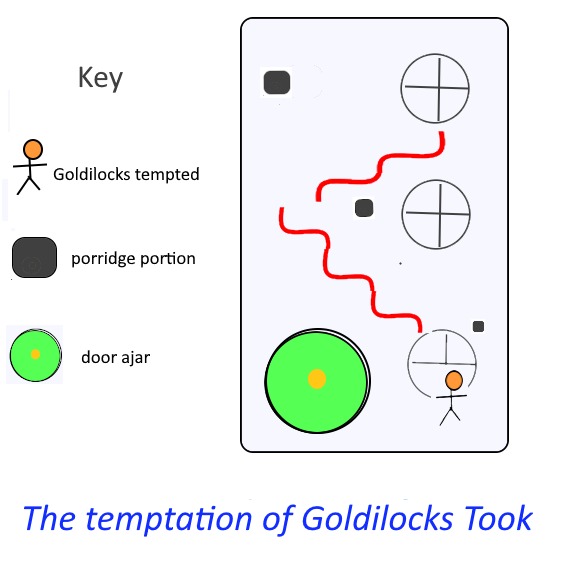
Eat earth. Dig deep. Drink water.
- Points: 2 417
Arien
Posts: 1982
Joined: Thu May 07, 2020 8:56 pm
Oh yes!!!! I actually completely forgot about the Rapunzel-like elements of Lúthien’s tale - imprisoned in a great tree by her father, she magically grows her hair to great lengths in order to create a means of escape, enchanting it into both a cloak of slumber and an escape rope…Chrysophylax Dives wrote: ↑Sun Jul 30, 2023 4:33 am
Rapunzel in the Elf-tower. Told in the Shire in the 4th Age (based upon possibly erroneous ideas of Elvish doors, as illustrated elsewhere).
As for Goldilocks Took, I would love to hear of her adventures in more detail
the explanatory diagram is wonderful. What about third porridge?cave anserem
- Points: 4 777
Tree
Posts: 3136
Joined: Sun May 17, 2020 7:54 pm
The diagram is quite good, yes. But on reflection 'Goldilocks and the three Beorns' is not only a better title but offers by far the better story - and keeps the bears, unlike the Bolgers.
But my counsel is the tower-tree-egg imprisonment story with the hair instead of stairs. Its got a grisly bit with the handsome prince losing his vision, no? That is good because the same egg diagram that makes a tower can be turned once again on its side to make an eye. So you could save on the illustration costs.
But my counsel is the tower-tree-egg imprisonment story with the hair instead of stairs. Its got a grisly bit with the handsome prince losing his vision, no? That is good because the same egg diagram that makes a tower can be turned once again on its side to make an eye. So you could save on the illustration costs.
Eat earth. Dig deep. Drink water.
- Points: 2 417
Arien
Posts: 1982
Joined: Thu May 07, 2020 8:56 pm
Eyes on towers - now, that really would be a fairytale *stares at Peter Jackson*
cave anserem
- Points: 4 777
Tree
Posts: 3136
Joined: Sun May 17, 2020 7:54 pm
All towers have eyes as their end, Goose. That is the reason to climb the staircase - to look with your own eyes upon the view. No need to invoke the movies.
Eat earth. Dig deep. Drink water.
- Points: 2 417
Arien
Posts: 1982
Joined: Thu May 07, 2020 8:56 pm
Ah, but towers have two purposes: that which you mention, to gain sight from a height; the other, to imprison…
cave anserem
- Points: 4 777
Tree
Posts: 3136
Joined: Sun May 17, 2020 7:54 pm
I had a thought you might say something like that.Silky Gooseness wrote: ↑Sun Aug 06, 2023 8:54 am Ah, but towers have two purposes: that which you mention, to gain sight from a height; the other, to imprison…
I disagree. A dungeon is where the folks are usually imprisoned, underneath the tower. Within the dark, slimy stone walls of the dungeon there is no view. A prisoner at the top of a tower is an eye whose hand is bound, one who sees but is impotent to act on that vision, a particular kind of far-seeing vision that often (not always) speaks of traditional gender roles. So with the Rapunzel story we get the maiden who sees but is imprisoned and the prince who wanders freely but is blind.
Eat earth. Dig deep. Drink water.
- Points: 2 817
New Soul
Posts: 3091
Joined: Thu Sep 02, 2021 6:24 am
Chrys: Thanks, true I have. 
Just call me Aiks or Aikári. Notify is off.
Find me stuff in Gondolin.
And let us embark to Valinor!
Find me stuff in Gondolin.
And let us embark to Valinor!
- Points: 4 777
Tree
Posts: 3136
Joined: Sun May 17, 2020 7:54 pm
Aiks, I am confused.
@Silky Gooseness, now I had a thought that you would say something like 'I don't know why you think I am disagreeing with you Chrysophylax Dives.'
Which would trip me up.
The end of a tower being an eye on the world allows many variants - even seagulls.
@Silky Gooseness, now I had a thought that you would say something like 'I don't know why you think I am disagreeing with you Chrysophylax Dives.'
Which would trip me up.
The end of a tower being an eye on the world allows many variants - even seagulls.
Eat earth. Dig deep. Drink water.
- Points: 2 817
New Soul
Posts: 3091
Joined: Thu Sep 02, 2021 6:24 am
I gave only confirmation to a post of you of 21 July and Troelsfo's right behind yours. Nothing to be confused about. 
Nice picture outlinings.
Nice picture outlinings.
Just call me Aiks or Aikári. Notify is off.
Find me stuff in Gondolin.
And let us embark to Valinor!
Find me stuff in Gondolin.
And let us embark to Valinor!
- Points: 2 417
Arien
Posts: 1982
Joined: Thu May 07, 2020 8:56 pm
@Chrysophylax Dives ah yes, like Húrin, I suppose?! Or even Maedhros, imprisoned on the mountain? And yet still imprisoned.
cave anserem
- Points: 4 777
Tree
Posts: 3136
Joined: Sun May 17, 2020 7:54 pm
@Silky Gooseness, I was not sure if you agreed with me or not, but I am happy to see that you do! I'm not sure how Maedhros hanging by a wrist from the face of a precipice of Thangorodrim counts as a prisoner in a tower, so i'll pass over that, but the Hurin case is almost archetypal.
Therefore Hurin was brought before Morgoth, for Morgoth knew by his arts and his spies that Hurin had the friendship of the King; and he sought to daunt him with his eyes. But Hurin could not yet be daunted, and he defied Morgoth.
(The Children of Hurin, Chapter 3)“You shall see and you shall confess that I do not lie," said Morgoth. And taking Hurin back to Angband he set him in a chair of stone upon a high place of Thangorodrim, from which he could see afar the land of Hithlum in the west and the lands of Beleriand in the south..."Therefore with my eyes you shall see, and with my ears you shall hear, and nothing shall be hidden from you."
Eat earth. Dig deep. Drink water.
- Points: 2 417
Arien
Posts: 1982
Joined: Thu May 07, 2020 8:56 pm
He’s not a prisoner in a tower per se, but being imprisoned in a high up spot where he could presumably see, but not act, seemed to fit in with the theme!
cave anserem
- Points: 4 777
Tree
Posts: 3136
Joined: Sun May 17, 2020 7:54 pm
I have transformed from an Ent into a winged creature and now, like the Goose, can see the world in motion from a great height! Unfortunately, no sign of any Entwives yet. Still, a word to a feathered friend: @Silky Gooseness, I am tremendously grateful for your conversation, which has an almost unnerving ability to point me where i had not noticed or considered.
Some questions now swirling around in my head.
1. Gender. If it is correct that the Rapunzel story captures some traditional image of gender divisions it is certainly true that Tolkien's stories tell mainly of males, and so does it make sense to say that when a male hero is imprisoned in a tower they take on a female role? Probably this could be phrased better, but I'd never thought about this before.
2. The Ring. Frodo is a prisoner in the tower in the brief period that he does not have the Ring, which before and after is connected to his vision of the Eye. How to make sense of this?
3. Art vs. Necromancy. In some sense the gendered eye-in-the-tower is subsumed by or transposed into a more fundamental division between mortals: the Elf-friend and the necromancer. Sauron is the Eye in the Tower who sees in order to control what is seen, and one mortal model of high-vision from a tower. But on the margin of the story is the eye-in-the-white-tower in the West, that looks only to see (and only out over the sea). The original eye in this Elf-tower was a mortal eye, that of Elendil, and he knew better than most the consequences of attempting to take for oneself what it is permitted, to a mortal, only to see. In other words, the 'proper' use of a tower for vision seems to be vision without action, which is almost an imprisoned view.
All of which leads back to an Elvish Rapunzel, whose long staircase-like hair appears as an Elvish Ring of Power that promises too much in the hands of mortals. So the witch who cuts the hair is either Sauron, who draws out the latent evil of such a promise - and falling whilst climbing the hair and being blinded on the thorns is as if to become a wraith, or Ilúvatar acting through the power of the Valar, cutting the Straight Road so that mortals can no longer sail to Valinor.
As the Thrush, I glimpse on the horizon a Dwarf gifted a lock of hair.
Context of this post: it is now 5.30 am. I have been sitting here for the last two hours because my youngest child awoke at 3.00 am with a gift for me in her diaper (nappy, as i would say), and refused to go back to sleep.
Some questions now swirling around in my head.
1. Gender. If it is correct that the Rapunzel story captures some traditional image of gender divisions it is certainly true that Tolkien's stories tell mainly of males, and so does it make sense to say that when a male hero is imprisoned in a tower they take on a female role? Probably this could be phrased better, but I'd never thought about this before.
2. The Ring. Frodo is a prisoner in the tower in the brief period that he does not have the Ring, which before and after is connected to his vision of the Eye. How to make sense of this?
3. Art vs. Necromancy. In some sense the gendered eye-in-the-tower is subsumed by or transposed into a more fundamental division between mortals: the Elf-friend and the necromancer. Sauron is the Eye in the Tower who sees in order to control what is seen, and one mortal model of high-vision from a tower. But on the margin of the story is the eye-in-the-white-tower in the West, that looks only to see (and only out over the sea). The original eye in this Elf-tower was a mortal eye, that of Elendil, and he knew better than most the consequences of attempting to take for oneself what it is permitted, to a mortal, only to see. In other words, the 'proper' use of a tower for vision seems to be vision without action, which is almost an imprisoned view.
All of which leads back to an Elvish Rapunzel, whose long staircase-like hair appears as an Elvish Ring of Power that promises too much in the hands of mortals. So the witch who cuts the hair is either Sauron, who draws out the latent evil of such a promise - and falling whilst climbing the hair and being blinded on the thorns is as if to become a wraith, or Ilúvatar acting through the power of the Valar, cutting the Straight Road so that mortals can no longer sail to Valinor.
As the Thrush, I glimpse on the horizon a Dwarf gifted a lock of hair.
Context of this post: it is now 5.30 am. I have been sitting here for the last two hours because my youngest child awoke at 3.00 am with a gift for me in her diaper (nappy, as i would say), and refused to go back to sleep.
Eat earth. Dig deep. Drink water.
- Points: 4 777
Tree
Posts: 3136
Joined: Sun May 17, 2020 7:54 pm
I think I'm approaching this a bit wrong. I've started Christopher Tolkien's 'Beren and Luthien' edition and am looking to see how the Rapunzel theme is developed or altered over the years. I have to be honest and say that before a certain Goose made the connection with Luthien it had not occurred to me - utterly obvious though it is once you see it. Rather, I was merely working on the stairs = ladder = rope theme (which was also put in my head by the Goose - a really rather remarkable Goose!).
Postscript: The 2018 'Beren and Luthien' does not give all versions but on the tree-captivity gives only the BLT version. 'The Lay of Leithian' (HoMe III) gives what appears to be exactly the same story (in verse). 'The Silmarillion' version abbreviates the wonderful magical spell that generates the amazing hair growth into a couple of lines, but referencing 'The Lay of Leithian'. In other words, from a quick inspection the Rapunzel theme is there from the beginning and does not change. But it is worth spelling out the longer version. Here some snippets from the 'Lay':
And now, the moment, awful and terrible, awesomely frightening to behold, the self-shearing that provides the raw material out of which the stairs are woven - stairs that are not ascended, but descended, the original act of Elvish escape from deathlessness (really, the Goose is right on the distinction between view and imprisonment - it seems related to direction: up or down the stairs, and also who is doing the climbing up or down):
Postscript: The 2018 'Beren and Luthien' does not give all versions but on the tree-captivity gives only the BLT version. 'The Lay of Leithian' (HoMe III) gives what appears to be exactly the same story (in verse). 'The Silmarillion' version abbreviates the wonderful magical spell that generates the amazing hair growth into a couple of lines, but referencing 'The Lay of Leithian'. In other words, from a quick inspection the Rapunzel theme is there from the beginning and does not change. But it is worth spelling out the longer version. Here some snippets from the 'Lay':
-- Any flying geese please note the distinction between imprisonment in a dungeon and imprisonment in a tower/tree.In angry love and half in fear Thingol took counsel his most dear to guard and keep. He would not bind in cavems deep and intertwined sweet Lúthien, his lovely maid, who robbed of air must wane and fade, who ever must look upon the sky and see the sun and moon go by.
--- Included because this seems to have some bearing on the much later Hobbit mushroom drawings of the Elf-towers.Thither at whiles they climbed and brought all things she needed or besought; but death was his, whoso should dare a ladder leave, or creeping there should set one by the tree at night; a guard was held from dusk to light about the grey feet of Hirilom and Lúthien in prison and forlom.
--- @Saranna, I cannot recall if you noted these last lines in your essay on water?And all names of things
tallest and longest on earth she sings:
the locks of the Longbeard dwarves; the tail
of Draugluin the werewolf pale;
the body of Glómund the great snake;
the vast upsoaring peaks that quake
above the fires in Angband’s gloom;
the chain Angainor that ere Doom
for Morgoth shall by Gods be wrought
of steel and torment. Names she sought,
and sang of Glend the sword of Nan;
of Gilim the giant of Eruman;
and last and longest named she then
the endless hair of Uinen,
the Lady of the Sea, that lies
through all the waters under skies.
And now, the moment, awful and terrible, awesomely frightening to behold, the self-shearing that provides the raw material out of which the stairs are woven - stairs that are not ascended, but descended, the original act of Elvish escape from deathlessness (really, the Goose is right on the distinction between view and imprisonment - it seems related to direction: up or down the stairs, and also who is doing the climbing up or down):
I passed over the bit with a loom requested for the spinning...Then groping she found her little shears, and cut the hair about her ears, and close she cropped it to her head, enchanted tresses, thread by thread. Thereafter grew they slow once more, yet darker than their wont before. And now was her labour but begun: long was she spinning, long she spun...
Eat earth. Dig deep. Drink water.
- Points: 4 777
Tree
Posts: 3136
Joined: Sun May 17, 2020 7:54 pm
OK. Yes, you are correct. It took me a while to get there. In retrospect, I should have known not to quibble.Silky Gooseness wrote: ↑Sun Aug 06, 2023 8:54 am Ah, but towers have two purposes: that which you mention, to gain sight from a height; the other, to imprison…
Eat earth. Dig deep. Drink water.
- Points: 4 777
Tree
Posts: 3136
Joined: Sun May 17, 2020 7:54 pm
Jack and the beans certainly fits the theme so far. I think only Hobbits would tell this story (note the self-aware modern guilt of the end of this modern retelling).
Edit: actually, there is an obvious echo of this fairy-story in LotR. Compare:
1. Fee-fi-fo-fum
2. fear! fire! foes! awake!
Edit: actually, there is an obvious echo of this fairy-story in LotR. Compare:
1. Fee-fi-fo-fum
2. fear! fire! foes! awake!
Eat earth. Dig deep. Drink water.
- Points: 4 777
Tree
Posts: 3136
Joined: Sun May 17, 2020 7:54 pm
So, to bump this conversation on a bit, we might turn to Macbeth and King Lear, or even Hamlet and the ghosts of old Denmark, on the one hand, or the Arabian Nights on the other?
Eat earth. Dig deep. Drink water.
- Points: 2 417
Arien
Posts: 1982
Joined: Thu May 07, 2020 8:56 pm
Jack and the Beanstalk seems a very fitting one for Hobbits - what with their reputation for being simple folk, and being largely centred around food…
Interesting that you mention Macbeth, King Lear, Hamlet: those are rather darker tales of murders, death and ghostliness. Would you have ghost stories in Middle-earth? There are dark rumours about Gollum as a ghost that drinks blood - I can’t think of any other references to ghosts right now - but given the nature of death and in death in M-e, it’s an interesting thought
Interesting that you mention Macbeth, King Lear, Hamlet: those are rather darker tales of murders, death and ghostliness. Would you have ghost stories in Middle-earth? There are dark rumours about Gollum as a ghost that drinks blood - I can’t think of any other references to ghosts right now - but given the nature of death and in death in M-e, it’s an interesting thought
cave anserem
- Points: 3 817

Mahal
Posts: 3173
Joined: Wed Aug 05, 2020 3:32 pm
What about the Mewlips and the Last Desert and Were-worms? Doesn't the Red Book contain Hobbit folklore?
The world was fair in Durin's Day.
- Points: 4 777
Tree
Posts: 3136
Joined: Sun May 17, 2020 7:54 pm
Drifa, tis a good point. The first edition of The Hobbit contains a sprinkling of references to what we today might call folklore, especially at the very begining. Most of that was then cut, but still leaving a few crumbs of apparent Hobbit folklore, and (if i recall the Mewlips correctly) some little more found its way in at Rivendell in Bilbo's song. (By the way, I vaguely recall Christopher Tolkien in HoMe giving a long explanation of how Bilbo's song as printed was the wrong song! But i may be confusing things.)
Goose, glad to see you back. You prefer Shakespeare to the Arabian Nights for your Tolkien, eh? Not that this is relevant, but in general in the wider Tolkien literature i am taken aback by the presumption that folklore must be the kind of thing found in Grimm, or otherwise Germanic or Northern. Back in the days of Charles Dickens the Arabian Nights was the great fairytale collection of the age, and Tolkien picked up on that.
Goose, glad to see you back. You prefer Shakespeare to the Arabian Nights for your Tolkien, eh? Not that this is relevant, but in general in the wider Tolkien literature i am taken aback by the presumption that folklore must be the kind of thing found in Grimm, or otherwise Germanic or Northern. Back in the days of Charles Dickens the Arabian Nights was the great fairytale collection of the age, and Tolkien picked up on that.
Last edited by Chrysophylax Dives on Sat Sep 16, 2023 2:08 am, edited 1 time in total.
Eat earth. Dig deep. Drink water.
- Points: 4 777
Tree
Posts: 3136
Joined: Sun May 17, 2020 7:54 pm
Who taught Gollum how to play the riddle game? Obviously, a master riddler in a hole of the long, long ago. Not yet a folktale or fairy-story, perhaps, but surely with the potential to become one. But i think only @Drifa could pen this tale!Riddles were all he could thinkk of. Asking them, and sometimes guessing them, had been the only game he had ever played with other funny creatures sitting in their holes in the long, long ago, before he lost all his friends and was driven away, alone, and crept down, down, into the dark under the mountains.
Eat earth. Dig deep. Drink water.
- Points: 2 417
Arien
Posts: 1982
Joined: Thu May 07, 2020 8:56 pm
I love the Arabian Nights, actually! I just couldn’t, on the spot, think of any links - I’ve not read it in its entirety for a while. The one that stuck with me most was the fisherman who caught the magic fish, but there are probably some connexions to be drawn about cursed magical objects, which purport to give the owner (wearer) great power but in fact draw you to your doom. There are definitely enchanted rings. I must think on this further…
As to Gollum, his Grandmother/matriarch would probably be a good figure for fairytale? There’s often a wise woman or crone figure lurking in the background of fairytales.
As to Gollum, his Grandmother/matriarch would probably be a good figure for fairytale? There’s often a wise woman or crone figure lurking in the background of fairytales.
cave anserem
- Points: 4 777
Tree
Posts: 3136
Joined: Sun May 17, 2020 7:54 pm
Gollum grandmother is just waiting for portrayal, yes! But yes she is in the background - with perhaps some hole politics going down. But who is the main character whoever it was who taught Gollum his first riddle? And what was Gollum's first riddle? That is why we need Drifa.
On the Arabian Nights you should not get me started as it is my other obsession after stairs. I am convinced that The Hobbit is a remix of the tale of the 40 Thieves. I've put all this on hold while i focus on stairs for the time being, though.
The fisherman who catches the magic fish also looms large in my dim childhood memories of these tales. Possibly it was the illustration? Or just something magical in the very idea of a fish swallowing a ring.
Here is a question (serious): did you do that by accident, or was it intended? I mean point to another folktale that looms in Middle-earth (the story of Gollum, in fact).
On the Arabian Nights you should not get me started as it is my other obsession after stairs. I am convinced that The Hobbit is a remix of the tale of the 40 Thieves. I've put all this on hold while i focus on stairs for the time being, though.
The fisherman who catches the magic fish also looms large in my dim childhood memories of these tales. Possibly it was the illustration? Or just something magical in the very idea of a fish swallowing a ring.
Here is a question (serious): did you do that by accident, or was it intended? I mean point to another folktale that looms in Middle-earth (the story of Gollum, in fact).
Eat earth. Dig deep. Drink water.
- Points: 2 417
Arien
Posts: 1982
Joined: Thu May 07, 2020 8:56 pm
The ghost that drinks blood? Yes, I think there’s definitely folktale in that.
cave anserem
- Points: 4 777
Tree
Posts: 3136
Joined: Sun May 17, 2020 7:54 pm
i think you are confused on times. In the LotR version, Gollum was playing riddles before the Ring and the murder and all that then followed. As a story, though, i would urge the original version, where Gollum is stupid not evil - and ends up alone not because he has been cast out of his hole by his grandmother but because when the goblins came he got separated from his friends and relations. But he would have been stupid in the same way when still in the the hole.
you did not answer my question.
you did not answer my question.
Eat earth. Dig deep. Drink water.
- Points: 4 777
Tree
Posts: 3136
Joined: Sun May 17, 2020 7:54 pm

Last edited by Chrysophylax Dives on Sat Sep 14, 2024 9:59 pm, edited 8 times in total.
Eat earth. Dig deep. Drink water.
- Points: 2 417
Arien
Posts: 1982
Joined: Thu May 07, 2020 8:56 pm
I’m sorry to have upset you with any comment of mine - I do assure you it was not intentional. You are indeed doing well. As to your question, friend: did I do it on purpose - I’m not quite sure which bit “it” is aimed at: what are you asking if I did on purpose? (Although the answer is likely not. I am quite spontaneous and tend to thought-dump rather than deeply consider, alas.)
cave anserem
- Points: 4 777
Tree
Posts: 3136
Joined: Sun May 17, 2020 7:54 pm
What? If this is doing well then heaven help me when I'm doing badly. Maybe I misunderstand, but never mind. The question I asked above (a long while back now) was in reference to this:
So what you do here is (a) deny ability to make any connections between the Arabian Nights and Middle-earth and then (b) mention the single most obvious connection - the story of the fisherman who finds a magic ring inside a fish, which is surely somewhere behind the story of Deagol and Smeagol.Silky Gooseness wrote: ↑Sat Sep 16, 2023 7:48 am I love the Arabian Nights, actually! I just couldn’t, on the spot, think of any links - I’ve not read it in its entirety for a while. The one that stuck with me most was the fisherman who caught the magic fish, but there are probably some connexions to be drawn about cursed magical objects, which purport to give the owner (wearer) great power but in fact draw you to your doom. There are definitely enchanted rings. I must think on this further…
I just found it fascinating to read the post. It is like a magic circle, or a magic trick. Actually, it is a bit like a riddle - the first part lulling us with distraction while the answer is then placed before our eyes without anyone quite noticing what has happened.
All of this thread seems a long time ago now, eh?
Eat earth. Dig deep. Drink water.
- Points: 2 417
Arien
Posts: 1982
Joined: Thu May 07, 2020 8:56 pm
Ah!! Sorry - yes. I meant that when you first asked the question I couldn’t think of any links; but by the time I had made the post you quoted, I had finally thought of one. Excuse me - goose brain.
cave anserem
- Points: 4 777
Tree
Posts: 3136
Joined: Sun May 17, 2020 7:54 pm
...
Last edited by Chrysophylax Dives on Sat Sep 14, 2024 10:20 pm, edited 1 time in total.
Eat earth. Dig deep. Drink water.
- Points: 4 777
Tree
Posts: 3136
Joined: Sun May 17, 2020 7:54 pm
Tailbiter returned to the Lake. Another necromancer required.
Last edited by Chrysophylax Dives on Sat Jul 13, 2024 5:49 pm, edited 1 time in total.
Eat earth. Dig deep. Drink water.
- Points: 2 417
Arien
Posts: 1982
Joined: Thu May 07, 2020 8:56 pm
I should have thought of it sooner (especially given your name!) but in truth it has been many long years since I read Farmer Giles! British and Welsh indeed but some of the names seem rather Latinate? I’m not sure what to derive from that.
cave anserem

