Malory and the Red Book of Westmarch
Forum Name: The Books
Forum Description: Discuss the various Books by J.R.R. Tolkien
URL:/display_topic_threads.asp?ForumID=24&TopicID=155483
Date Printed: Wednesday, October 06, 2004 at 08:03
Topic: Malory and the Red Book of Westmarch
------------------------------------------------------------------------
Posted By: halfir
Subject: Malory and the Red Book of Westmarch
Date Posted: Tuesday, October 05, 2004 at 03:02
‘Still, I wonder if we shall ever be put into songs or tales. We’re in one of course; but I mean: put into words, you know, told by the fireside, or read out of a great big book with red and black letters, years and years afterwards.’ (Sam to Frodo: TT The Stairs of Cirith Ungol - my bold emphasis).
Later this month Professor Verlyn Flieger - a leading Tolkien scholar and author of A Question of Time: Tolkien’s Road to Faerie, and Splintered Light: Logos and Language in Tolkien’s World will present a paper at a Tolkien conference organized by Marquette University - in which she argues that Sam’s reference is in fact a reference by Tolkien to a particular copy of Malory’s Morte D’Arthur.
[A note from Saranna, 2020; The text of this paper by Flieger evolved into the chapter ‘Tolkien and the idea of the book’ and can be found in: Flieger, Verlyn: Green Suns and Faërie; essays on J. R. R. Tolkien. Kent State University Press, 2012. Pages 41-53.]
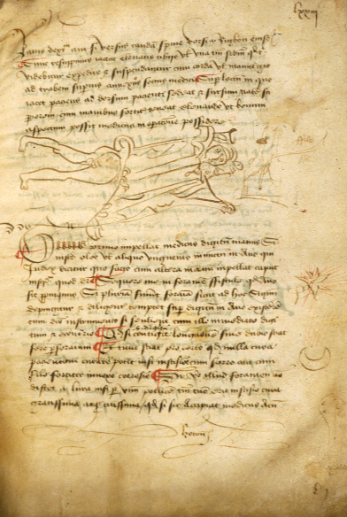
The phrase "big book with red and black letters" also describes an actual manuscript. This was the manuscript copy of Malory’s Morte D’Arthur discovered in the Fellows’ Library of Winchester College in 1934 and in the process of being edited for publication by Eugene Vinaver at the time Tolkien was writing.
It is a great big book with red and black letters. Red is important, and refers not to the elaborate decoration of initial letters at the head of chapters common in medieval manuscripts, but to a substantial portion of the book. All the proper names in the Winchester manuscript are entered in red ink, so that the pages are filled with "red and black letters."
Sam’s other phrase "years and years afterward" also evokes the whole Arthurian tradition, the survival in many manuscripts over many centuries of an historical event and characters. Flieger maintains that Sam’s description is derived from the Winchester manuscript, and that this manuscript was a material influence on Tolkien’s concept of the transmission of story through manuscript that emerges in his own work as the Red Book of Westmarch.
The manuscript had been found by Walter Oakeshott - a librarian at Winchester College Oxford in 1934.
Oakeshott writes of his find that at the urging of J.B. Oldham, an expert in 15th-16th century blind stamped book bindings and Librarian of Shrewsbury School (Kingsland), Oakeshott approached the Fellows’ Librarian for permission to enter the bedroom of the College Warden and open the safe containing medieval manuscripts in order to fill gaps in his knowledge of the Library’s holdings.
He goes on to say:
Accordingly, when at last I approached the safe with the key in my hands, it was with some excitement. I slid aside the metal grille, and was dashed to see at a glance that on the twenty or thirty manuscripts not a single medieval binding remained . . . It was a disappointment. But one did not get a chance every day to handle medieval books, so I pulled them out one by one and ran through one after another, catching a glimpse of an illumination here, or an interesting-looking text there, but making no systematic observations or notes. Two or three which were not in Latin but were in English caught my eye. One was very fat, some 480 leaves, paper not vellum, the text prose not verse, clearly about King Arthur and his Knights, but lacking a beginning or an end. Be it admitted to my shame that I had never read Malory, and my knowledge of him was about as sketchy as my knowledge of most things has alas had to remain. But I made a vague mental note of this prose Arthurian manuscript, and passed on to the next item.
Oakeshott goes on to relate that "by good fortune" a few weeks later in preparing for a visit from the Friends of the National Library, he set out an exhibit of early printed books including several by Wynkyn de Worde (Caxton’s successor in the book trade). In order to prepare a label for exhibit, Oakeshott consulted a reference work where, he says, he "came across a sentence which made my heart miss a beat":
"The compilation of the Morte d’Arthur’, writes Duff, ’was finished in 1469, but of the compiler little is known save the name . . . No manuscript of the work is known, and though Caxton certainly revised it, exactly to what extent has never been settled."
Oakeshott goes on to tell how he went to Wells Bookshop in College Street, bought the Everyman edition of the Morte D’Arthur, and "sought out the Librarian of the Fellows’ Library and begged from him the key of the safe again, saying (what was indeed true) that there was some point I wished to check." With the edition alongside the manuscript, Oakeshott determined immediately that it was indeed a version of Malory and quickly discerned the degree to which Caxton had revised portions of the original author’s work.
Reading of the discovery in the newspaper, Eugene Vinaver--already well-established as an Arthurian scholar--quickly motored from Manchester to Winchester, followed, it is rumored, by "an aircraftman on a motor-cycle" (T.E. Lawrence). When asked to show Vinaver the manuscript, Oakeshott showed him the safe but stalled for a short time awaiting permission from the Warden and the Fellows. In time, Vinaver made secure his claim to scholarly privilege in the matter; the result of Vinaver’s research was the 3-volume The Works of Sir Thomas Malory (Oxford, 1947).
Eugene Vinaver was Professor of Medieval French during my time at Manchester University, in England, and I wish I had known then of his relationship with Tolkien- for he surely had one.
In 1933 Eugene Vinaver, who had also been at Leeds when Gordon, Tolkien’s close friend and scholarly collaborator was Professor of English Language there, followed him to Manchester where Gordon had been appointed Smith Professor of English Language and Germanic Philology at the University of Manchester. (I later knew his wife-Ida Gordon who was a senior lecturer there).
Vinaver collaborated with Gordon on a comparison of the text of the alliterative Morte D’Arthur and the Winchester manuscript of Malory which had been discovered-as we have seen- in 1934.
So the links back to Tolkien are very close indeed and it will be of great interest to learn what arguments Professor Flieger will use to link Sam’s comments on the Stairs of Cirith Ungol to a Malorian manuscript found in the safe of the Warden of Winchester College Oxford in 1934!
N.B. Please note that apart from my own personal knowledge of some aspects of this story my sources are from Marquette University’s website, website information on Walter Oakeshott, and Tolkien the Medievalist edt. by Jane Chance.
Posted By: Naith Liathant
Date Posted: Tuesday, October 05, 2004 at 06:51
This is all very interesting, Halfir. I have never read any Flieger, let me start by saying that. Let me also say that the following shall simply be my assertion regarding the mention of the Red Book of Westmarch and Sam’s speech quoted above.
I have always assumed that since Tolkien aspired, in a sense, to create a kind of mythology that pleased him more so than Arthurian myth, through the Lord of the Rings and the great works surrounding it that the Redbook in this sense was a nod toward his own inspiration. Much as many aspects of the tales comprise themes / language / geography or other acknowledgements to these sources. In this I generally allude to adaptations of cultures and language and myth and folk tale.
More specifically and to get to the point, I always assumed that the Red Book would be a nod to the Red Book of Hergest. A fourteenth century manuscript that, together with the White Book of Rhydderch, comprises the Mabinogion. This is of prime import to the student of Arthurian myth. It is a collection of short stories and Welsh myth and folk tale.
Properly this consists of only four tales, none of which are Arthurian but it has come to include the Arthurian works of Gereint and Enid, Culhwch and Olwen, Peredur and The Dream of Rhonabwy. The most famous translation (arguably) of Lady Charlotte Guest also includes the story of Taliesin.
Alternatively and perhaps less convincingly, since none other than myself, that I am aware of, have linked the following, it could allude to another Red Book entirely, or at the same time, which I think quite likely. I believe this since Tolkien was so very clever and genius and knowledgeable of so many alternate fields of literature and lore.
The Red Book of Appin, asserts Montague Summers, was a manuscript that contained ’ a large number of magic runes and incantations for the cure of cattle disease, the increase of flocks and the fertility of fields. This document, which must be of immense importance and interest, when last heard of was (I believe) in the possession of the now - extinct Stewarts of Invernahyle. This strange volume, so the story ran, conferred dark powers on the owner, who knew what inquiry would be made ere the question was poised; and the tome was so confected with the occult arts that he who read it must wear a circlet of iron around his brow as he turned those mystic pages.’
The ’Tradition’ of folklore said this tome ’was stolen from the devil by a trick’.
Now I am not casting aspersions upon the use of the Red Book as a symbol, and remember I do say that there is a dual image here, but should Tolkien have been privy to the same understanding as Summers regarding this, the reference to the circlet of iron is certainly worth its weight in gold, even if only in entertainment value.
Source: History of Witchcraft & Demonology, Montague Summers
Posted By: halfir
Date Posted: Tuesday, October 05, 2004 at 15:35
Naith: Quite fascinating! Until Professor Fleiger’s paper reaches a wider public (I have written to Marquette to discover if and when they are going to publish it and the other papers or if we can obtain copies of it and the other papers) I will not try and second-guess what she is going to say.
With regard to your suggestion of the Red Book of Hergest I would draw your attention to Letter # 131 and Tolkien’s known aversion to the Arthurian canon.
As to the more recondite link to the Red Book of Appin my own feeling is that Tolkien, a very devout Roman Catholic would have eschewed anything of this nature- if he knew about it- but I admit the ’iron crown’ reference is most intriguing.
However, I think that the physical format of the book is what will play a major in Professor Flieger’s argument. Have you any idea in what format the Red Book of Hergest appeared?
But your thesis is most interesting even though it may - as may Professor Flieger’s -owe more to ’applicability’ than to authorial intent. However, in your favor is the fact that Tolkien was very au fait with the Welsh Language and with its tales- and this nods in the direction of The Red Book of Hergest.
Altogether a most fascinating and excellent piece of detective work and thinking on your part.
Posted By: Naith Liathant
Date Posted: Tuesday, October 05, 2004 at 16:41
halfir: The paper in itself will be most fascinating when you obtain a copy of it. Although I tend to agree regarding Tolkien’s theoretical and most assured dislike for the Red Book of Appin itself, the information above is the research of Montague Summers, himself a Catholic Priest (1880 - 1948). If Tolkien had known of this, and the research undertaken, or had in his own way discovered the tale of the Red Book of Appin, he might have had the darker part of his imagination stirred to form the link. The Red Book of Westmarch being Translations from Elvish and that being the recounting of the War of the Ring and destruction of the One Ring. The fact that the reader of the Red Book of Appin would have to wear a circlet of iron to wield the supposed dark power in the book might have been something that lit a metaphorical light bulb in the Tolkien mind.
To couple that Red Book symbolism to either the Red Book of Hergest or indeed the Morte D’Arthur, and thereby form two distinctive links to the Red Book of Westmarch as having some hidden meaning. The latter would certainly be the reason linked through Sam’s words and certainly a less dark and more accessible and well known possibility, also it fits with the language used in Sam’s speech so in that sense my comment truly is an aside. A fan's inner musing.
The reason I linked the Red Book of Appin to the Red Book of Westmarch is highlighted above. I certainly surmise that Tolkien, though not condoning such texts, would know that a text in itself is only as tainted as the reader allows it to be and as dangerous as the credence it is granted, and therefore to not necessarily eschew such as a source of inspiration when creating the dark power of the Rings Trilogy. However, that said, I doubt Tolkien would be putting that link to the fore!
So yes, tenuous, yet food for thought, and it was something to share!
I always thought his aversion to Arthurian myth was more born of aesthetic frustration and dissatisfaction. I shall have a read of said letter, thank you for the reference, could have been looking for that all night!
I would have to do more research as to the form of the Red Book of Hergest. I know it was written 1375 - 1425 but was not compiled into the Mabinogion until the mid nineteenth century. I would need to do some research to discover more. That did originally deal only with four tales, Pwyll, Branwen, Manawydan, and Math, three of which concern the hero named Pryderi. To reiterate, none of these were Arthurian.
<< Edit : My apologies if none of this makes any sense, blame my sleep deprived self, but this is an interesting discussion, and as I said, I rarely get out of Minas Tirith and P+FF, so I wanted to answer you speedily. >>
Posted By: halfir
Date Posted: Tuesday, October 05, 2004 at 17:34
Naith: it was something to share!
My dear sir, you do yourself an injustice! Something to share! It was a veritable horn of plenty- a cornucopia of stimulating and thought provoking ideas. I am delighted that you allowed it to venture outside the walls of Gondor (where I rarely venture as my distaste for the stewards has tainted my relations with your fair city and kingdom- even though I know that it is now in good hands!)
BTW did you know that Summers was very much used as a ’source’ document for the Dennis Wheatley Black Magic stories- The Devil Rides Out etc?
I will let you know Marquette’s response.
Posted By: Laielinwen
Date Posted: Wednesday, October 06, 2004 at 01:06
Wow halfir! Very exciting news! Do share with us what you find out.
Naith, as always you put forth excellent information that is well researched and pondered! The quality of your words is high as always. I’d expect no less. I’m thrilled to see you interacting with my oldest plaza friend. (erm... not talkin’ age J)
Posted By: halfir
Date Posted: Wednesday, October 06, 2004 at 02:13
Laie: I should hope not! After both my waistline and my age passed 46 I started counting backwards! I now admit to 21 -permanently - for both!
Posted By: Laielinwen
Date Posted: Wednesday, October 06, 2004 at 02:32
J backwards is good!
Posted By: Saranna
Date Posted: Wednesday, October 06, 2004 at 02:42
This is brilliant stuff - why have I gone and discovered it just as I have to dash out to my exercise class for elderly ladies? Don’t go away! :)
Saranna Wednesday, October 06, 2004 at 08:18 Warrior of Imladris
halfir, I am fascinated by your argument and indeed wholly convinced. I feel, however, that the suggestions of Naith are also interesting. When I first read LOTR long ago my assumption was that the Red Book of Hergest was being evoked, one of those associations that JRRT liked to play with (Crickhollow/Crickhowell, for another example). However, your description of the Malory text, which sadly I have never seen, does make it seem 99.99% clear to me that Sam's reference is to that work. Did Tolkien see it while Vinaver was editing, or do we not know that?
Perhaps I could find the answer to this following question in the Letters, which I have not read for some years~ (the Plaza as an instrument that prods one into re-reading would be a possible thread) ~ but could you clarify for me whether JRRT's dislike was actually toward the Arthurian cycle per se, or toward it's "Fenchification" in the Middle Ages? That is, was he trying to retrieve something that he felt had become obscured in Arthurian legend, or more radically, trying to provide what he believed that cycle never to have provided.
Dear me, what a pompous sentence. I have every confidence in your power to decipher it.
halfir Wednesday, October 06, 2004 at 16:34 High Lord of Imladris Points: 12914 Posts: 16290 Days: 1143
Did Tolkien see it while Vinaver was editing, or do we not know that?
Hopefully Professor Flieger will throw some light on that aspect. There is of course the connection between Gordon- Tolkien's close associate, and Vinaver, and all three were at Leeds.
Also C S Lewis reviewed (disagreeably I think) Vinaver’s edition (or rather his conclusions) when it was published in 1947 and Lewis and Tolkien were also close. And Vinaver himself refers to attending a lecture by Tolkien at Oxford during the period of his work on Malory, so I suspect in the close environment of Oxford University Tolkien was well aware of the work Vinaver was doing and either had sight of or had graphic description of Malory’s discovered work. (It would be nice to know if Vinaver was ever invited to an Inklings’ meeting!)
However, that is my supposition- I hope Verlyn Flieger will give us detailed confirmation.
My biggest irritation is that Vinaver- then I think Professor Emeritus was - as a fairly old man still at Manchester when I was- and I had no idea of his connection with Tolkien. Of Ida Gordon's I did - and she was no fan!
Tolkien's hostility to the Arthurian canon- which is set out perhaps at its crispest in Letter # 131 - the famous ';Waldman'; letter appears to revolve around the fact that it is a ';foreign'; transplant which does not adequately reflect England- but rather Britain; that its approach to 'faerie' is too excessive; and most fundamentally that it is overtly Christian:
';For reasons I will not elaborate, that seems to me fatal. Myth and fairy-story must, as all art, reflect and contain in solution elements of moral and religious truth (or error) , but not explicit, not in the known form of the ';primary'; real world. (I am speaking, of course, of our present situation, not of ancient pagan, pre-Christian days. And I will not repeat what I tried to say in my essay, which you read).
(Unfortunately HC does not tell us what essay Tolkien is referring to, but I am assuming it is the Lang Memorial lecture from 1939 ';On Fairy Stories'; which was first published in 1947 in ';Essays Presented to Charles Williams';)
I have not fed my readers with straw, neither will I be confuted with stubble
Saranna Thursday, October 07, 2004 at 02:50 Warrior of Imladris Points: 2316 Posts: 4627 Days: 445
Thank you, Halfir - Tolkien can always overthrow any assumptions one makes- by objecting to overtly Christian content, for example, when the simplistic view would be that as a Roman Catholic he would approve it. I understand your frustration over never having approached Vinaver on the subject of Tolkien. And envy you mixing with such legendary beasts! Having failed Oxford entrance due to my small Latin and no Greek at all, I was educated at Bedford College, when it was no longer for women only, under the redoubtable Kathleen Tillotson. Hot on Chaucer but not an environment in which one mentioned authors who had not yet done the decent thing, and died!
Yes, it must surely be On fairy-tales. I hope there will be more to this thread, it is fascinating.
"In sorrow we must go, but not in despair. For Behold! We are not bound forever to the circles of the world, and beyond them is more than memory."
mil35hokum Thursday, October 07, 2004 at 03:05
Apprentice of Gondor Points: 267 Posts: 22 Days: 201
i believe your reason might be valid enough but to me lotr is just magical interpretation of world war 2 i.e. when tolkein wrote the book . just assume mordor to be nazi germany of that time well italy can as well account for isengard gondor obviously would be england nd rohan be america or russia. anyways to one his own. it is just a point of view. what say?
death is just the beginning
AMIN OTHAR
halfir Thursday, October 07, 2004 at 03:19 High Lord of Imladris Points: 12914 Posts: 16290 Days: 1143
mil35hokum: I say- without being unkind- that you have not read the Introduction to FOTR when Tolkien makes it very clear that it has nothing whatsoever to do with WW2. Aspects of WW1 in the form of input to the character of Sam Gamgee and the foulness of the Dead Marshes and Mordor are there- but they are resonances- not direct comparisons.
Tolkien hated allegory in any shape or form and even the Malory example that I have given- and we have yet to read what Professor Flieger says - is not a template that Tolkien copies- simply a literary source that - if it turns out to be true - inspired him. No slavish copying took place, and while there is some symbolism in LOTR that is the most there is.
I have not fed my readers with straw, neither will I be confuted with stubble
halfir Thursday, October 07, 2004 at 03:33 High Lord of Imladris Points: 12914 Posts: 16290 Days: 1143
Saranna:
Under the redoubtable Kathleen Tillotson. Hot on Chaucer but not an environment in which one mentioned authors who had not yet done the decent thing, and died!
A very famous name! Professor Emeritus of Bedford College and a Vice President of the British Academy and an expert on Dickens, as well as Chaucer and Drayton if I am not mistaken.
I laughed out loud at your who had not yet done the decent thing, and died! comment. I fear this is still the case at many universities even now that the Master has died!
Academics dislike writers who are popular! Have you read John Carey's The Intellectuals and The Masses- Shippey quotes him in Tolkien: Author of the Century. Carey is scathing of what he calls the 'literary Sonnenkinder". I totally agree!
I am awaiting a reply from Marquette as to availability of papers or of their publication- but the conference hasn't yet taken place. I'd love to be there.
I have not fed my readers with straw, neither will I be confuted with stubble
Saranna Thursday, October 07, 2004 at 03:51 Warrior of Imladris Points: 2316 Posts: 4627 Days: 445
No, No don't give me any more to read! Well not yet. I must look up more Flieger. Your previous refs, are not, of course, in stock in the library service where I work, so I am seeking to mobilise the Interlending squad - a small race of orc-like people living mostly in the dark - -
Yes, Dickens also - though I never personally benefitted from her Drayton knowledge. I used to run into her in the BM when she was 90-ish and still working. Her memorial at Senate House was wonderful. A serious role-model for generations of women.
But on the subject of Tolkien and Malory - I do feel there is more to be said, beyond the big black and red letters, but as I am supposed to be working I had better leave this for now!
"In sorrow we must go, but not in despair. For Behold! We are not bound forever to the circles of the world, and beyond them is more than memory."
halfir Thursday, October 07, 2004 at 04:03 High Lord of Imladris Points: 12914 Posts: 16290 Days: 1143
There would be a link to Malory through C.S.Lewis as Lewis was a great fan of Malory.
Other than a brief reference by Tolkien in Letter # 145 in which a comparison of him with Malory in a review (which he showed to the Warden of Merton) inter alia got him a better college room, there is no reference in the Letters to Malory.
I have not fed my readers with straw, neither will I be confuted with stubble
Saranna Thursday, October 07, 2004 at 06:31 Warrior of Imladris Points: 2316 Posts: 4627 Days: 445
Well, but I waffle so much - I believe I meant that I see parallels with Malory's reworking of the Matter of Britain - as JRRT reworked the mythology of England. Let me try to clarify - though I am still supposed to be working!
Malory started off just copying from sources, and you can see in the early stages that he is functioning almost like a scribe. During the progress of the vast "Works" (OUP single-vol is the one I use), you can see him thrashing out something resembling modern English prose as he gets more involved with what he is doing, starts to write rather than transcribe, and finally ends up using words instead of copying them ("Ah, Syr Launcelot, there thou lyest . . . " etc).
Now, Tolkien set off writing tales to provide the context for his languages and mythology, and thanks to CT giving us so much of the early draught material, we can see a parallel development taking place, as the philologist evolves into the fiction writer. ("Nice Master." ) (I like the weepy bits!) And what a comfort it is to a struggling writer to see how dire some of those early draughts were, and to hear such statements as "I had no idea at first who Strider was," or words to that effect. So this is my tentative idea of a sort of affinity lying beyond the lettering!
halfir Thursday, October 07, 2004 at 18:39 High Lord of Imladris Points: 12914 Posts: 16290 Days: 1143
Saranna: You put me to shame! My simplistic assertion that: There would be a link to Malory through C.S.Lewis as Lewis was a great fan of Malory overlooks the obvious fact that Tolkien - well-versed in Medieval Literature himself - would certainly have studied and reflected on Malory!
Thanks for the timely intervention which saved me from making further simplistic gaffes!
Whether or not he saw the book that Vinaver was editing I do not know - perhaps Professor Flieger will help us there- but he certainly was aware of the Malorian epic and you fascinating extrapolation as to how it might have influenced him more directly than I had supposed makes interesting reading and gives food for thought. Moreover, Lewis'; own literary interests lay in that direction and doubtless the name of Malory came up fairly frequently at the meetings of the Inklings.
And I loved your perceptive comment:
as the philologist evolves into the fiction writer
He was truly seized by the 'awen' of the Bards!
I have not fed my readers with straw, neither will I be confuted with stubble
Saranna Friday, October 08, 2004 at 03:06 Warrior of Imladris Points: 2316 Posts: 4627 Days: 445
Your approbation, as ever, is music to my ears. I am still adding to my reading-list at a rate of 3 halfir suggestions per minute - -
halfir Friday, October 08, 2004 at 06:07
High Lord of Imladris Points: 12914 Posts: 16290 Days: 1143
Then your occupation must be a boon!
I have not fed my readers with straw, neither will I be confuted with stubble
halfir Friday, October 08, 2004 at 17:32 High Lord of Imladris Points: 12914 Posts: 16290 Days: 1143
I have now received a reply from Marquette University to confirm that they will be publishing the proceedings of their Tolkien conference- of which this paper is part- in late 2005-2006!
They have also given list of names of those also attending and giving papers- but the conference is already sold-out. The names read like a roll-call of Tolkienian scholarship:
Douglas Anderson Carl F. Hostetter David Bratman S. Gary Hunnewell Marjorie Burns John D. Rateliff Jane Chance Christina Scull Michael Drout Thomas A. Shippey Matt Fisher Arden R. Smith Verlyn Flieger Paul Edmund Thomas Michael Foster Richard C. West John Garth Arne Zettersten Wayne G. Hammond
So we are going to have to wait a while for Professor Flieger’s paper!
I have not fed my readers with straw, neither will I be confuted with stubble
Saranna Tuesday, October 12, 2004 at 08:48 Warrior of Imladris Points: 2316 Posts: 4627 Days: 445
Thanks halfir - you are working hard to keep us up to date. I have decided to subscribe to the new annual review of Tolkien scholarship, but suspect that lore-wise I shall still be in the Shire while you are crossing the Misty Mountains cold!
"In sorrow we must go, but not in despair. For Behold! We are not bound forever to the circles of the world, and beyond them is more than memory."
halfir Tuesday, October 12, 2004 at 23:18 High Lord of Imladris Points: 12914 Posts: 16290 Days: 1143
I'll remember to take some thermal long-johns!
I have not fed my readers with straw, neither will I be confuted with stubble
Saranna Wednesday, October 13, 2004 at 03:04 Warrior of Imladris Points: 2316 Posts: 4627 Days: 445
Fine - I shall stay warm just running to keep up!
halfir Wednesday, October 13, 2004 at 04:08 High Lord of Imladris Points: 12914 Posts: 16290 Days: 1143
I have not fed my readers with straw, neither will I be confuted with stubble
Saranna Thursday, October 14, 2004 at 08:46 Warrior of Imladris Points: 2316 Posts: 4627 Days: 445
BUMP! Someone please get this back on track - stop me and halfir (I mean halfir and I) waffling on!
Saranna Friday, October 22, 2004 at 06:49 Warrior of Imladris Points: 2316 Posts: 4627 Days: 445
Since no-one has done so, I shall have to commit a double-post just to let halfir know that I have got hold of a copy of Poetic Diction - last read 38 years ago. I suspect I understood far less of it than I thought at the time! So the rereading will be good for me!
Heron Friday, October 22, 2004 at 16:51 Guard of the Citadel Points: 3511 Posts: 3719 Days: 1128
I will not presume to address any of the points made above, not being a scholar of "logos," the Mabinogion, the cycles of either Chaucer or Arthur, or someone who can accurately use "exegesis" in a sentence. Which is why, halfir, although I admire the breadth of your learning, frankly, I tend to avoid the threads you open.
However, I thought the following might be of general interest. Dr. John Dexter of Providence College made an interesting point in his article "Invented Texts: Authority Conferred by the Non-Existent Author" (Ontological Linguistics, 10:3, 1967, pp. 398-432) Assuming, that is, that one has the stamina to get through all 30 pp (the last 4 are references) of his obscenely dense verbiage to find said point.
In essence, he states that many authors have claimed to base their works on texts which exist only in the imagination. Tolkien, obviously; also HP Lovecraft is another well-known example. (More recently, authors such as Laurie King have employed the same device, though she began writing well after Dexter wrote his piece.)
Providence College, being in Lovecraft’s home town, has an extensive collection of Lovecraftiana and it was while working on this that Dexter made a remarkable discovery. Lovecraft’s Necronomicon, of course, is his own invention, as is the entire history of "the mad Arab", Abdul Alhazred, its alleged author. Lovecraft even went so far as to invent a second book, the Liber Logaeth, which was supposedly an English translation of the Necronomicon from its original Arabic.
So far, nothing that any casual reader of Lovecraft, Smith, Howard, etc., doesn’t know. However, in his article, Dexter states that the Prov Coll library contains a book in an archaic form of Arabic (carbon dates to pre-Muhammed) that contains various blasphemous prayers and rituals to Angra Mainu (Ahriman). Angra Mainu and Morgoth, incidentally, bear considerable resemblance as the perverters-of-creation, though I’m sure that’s due to the nature of evil rather than to the Zoroastrian mythos being a strong source for Tolkien.
Furthermore, this book, according to Dexter, is a large book written in red and black ink. Lovecraft and Tolkien were (roughly) contemporaries and Lovecraft was an absurdly prolific letter-writer. Perhaps Tolkien’s book is a nod to the Necronomicon.
<Nessa Edit: Welcome Back. It is good to see you again!>
halfir Friday, October 22, 2004 at 23:43 High Lord of Imladris Points: 12914 Posts: 16290 Days: 1143
Heron: Great to see you in General Lore again- we have missed you. The last time I recall our meeting was your excellent thread on the Power of Song and Chant.
That is indeed very interesting information regarding Dexter's comment on Lovecraft and the book in 'red and black ink'. However, I tend to see it as coincidental rather than as impacting on Tolkien, and still find Professor Flieger's thesis persuasive.
Douglas A. Anderson who has written widely about Tolkien's sources (as well as editing the Annotated Hobbit) makes no mention at all of Lovecraft as having been in Tolkien’s range of fantasy reading, and nothing I have read in the Letters or in any of the many Tolkien biographies and studies of his literary inspirations makes any mention of Lovecraft, whereas he knew Vinaver and was at Oxford at the time Vinaver was editing the Malory work.
It would, however, be interesting to know what Professor Flieger thinks of the idea. Why don't you email her?
I have not fed my readers with straw, neither will I be confuted with stubble
Heron Sunday, October 24, 2004 at 17:00 Guard of the Citadel Points: 3511 Posts: 3719 Days: 1128
halfir: you're very kind! My comment above aside (and my apologies if it sounded terse; I meant to say simply that I generally have little that's meaningful to contribute after you present your evidence), I enjoy the lore threads but seldom have the time to research the questions at hand. I will email the Prof. you mention.
Grey Company Captain
TG Co-Supervisor
Steward of Dor Moretirith
Bears the Quill of Gondor
halfir Sunday, October 24, 2004 at 18:08 High Lord of Imladris Points: 12914 Posts: 16290 Days: 1143
Heron: There is a Kent State University Website (publishers of Flieger's book 'Splintered Light) and from that you might be able to get an email address for her, or, more likely - as has happened with me in other similar instances- they will forward your message and if you are lucky you'll get a reply!
www.kentstateuniversitypress.com
I have not fed my readers with straw, neither will I be confuted with stubble
Baelmyrrdn Monday, October 25, 2004 at 11:46 Nessa Admin Points: 11761 Posts: 14740 Days: 1150
This is an excellent and erudite discussion. So that it does not get lost, I would like to move this thread to Ad Lore. Will you permit me to do so?
Saranna Monday, October 25, 2004 at 11:52 Warrior of Imladris Points: 2316 Posts: 4627 Days: 445
"I generally have little that's meaningful to contribute after you present your evidence" - Heron, we all know that feeling.
As for Ad Lore, hooray and three cheers, say YES, halfir!
"In sorrow we must go, but not in despair. For Behold! We are not bound forever to the circles of the world, and beyond them is more than memory."
Heron Monday, October 25, 2004 at 14:02 Guard of the Citadel Points: 3511 Posts: 3719 Days: 1128
Hi Bael! Good to see you again!
Grey Company Captain
TG Co-Supervisor
Steward of Dor Moretirith
Bears the Quill of Gondor
halfir Monday, October 25, 2004 at 14:51 High Lord of Imladris Points: 12914 Posts: 16290 Days: 1143
Saranna: How could I ever deny my good friend Bael anything- especially as she always asks after the event? And I hope your Basic Lore Goldberry thread moves here too - it is a subject close to Bear’s heart and on which she and I have conferred in an earlier thread which I will reference if and when your Goldberry thread moves here. It’s a great thread BTW!
<Nessa edit: Mea Culpa...but in my defense, I throw my "hasty" little self on the mercy of the Council. And humbly point out that I did wait almost two hours...so I tried to be patient... >
Saranna Tuesday, October 26, 2004 at 07:48 Warrior of Imladris Points: 2316 Posts: 4627 Days: 445
"So here we all are in Ad Lore," said Saranna wonderingly, "and it's all feasting and fun . . . "
Nayeldraccon Thursday, October 28, 2004 at 01:40 Guardian of the Golden Wood Points: 3641 Posts: 8882 Days: 625
Oh my, my. halfir! You have touched on a weakness. I was inspired to learn French after reading an English copy of Le Morte'. Gimme a few days, and I'll pick you to pieces. Maybe I'll support you, maybe not. But I'll be here. It's a promise. I mean that.
Hmmmm...... In halfirian......ab imo pectore, adsum.
halfir Thursday, October 28, 2004 at 02:14 High Lord of Imladris Points: 12914 Posts: 16290 Days: 1143
Nay: Good to see you back again. I look forward to your contribution!
I have not fed my readers with straw, neither will I be confuted with stubble
Saranna Saturday, October 30, 2004 at 07:37 Warrior of Imladris Points: 2316 Posts: 4627 Days: 445
I am not in any position to make comments about Lovecraft, I fear. However, reverting to the Malory MS, I wonder if it was a very subtle reference to/acknowledgement of the ethereal ties binding LOTR and the Arthurian saga? No, everyone who drops in, I do NOT mean the LOTR is an allegory of Arthur! Tolkien felt that England lacked its own mythological dimension, and did not seem to feel that the Arthurian cycle filled the bill. It may have originated in Celtic times, and in the British Isles, but once carried overseas by fleeing Britons, and thence picked up by courtly French writers, it lost, he felt, its Englishness. Nevertheless, the echoes of Arthur are there. Indeed, long ago when I was very young, I would have assumed that any book called "The return of the King" must be about Arthur, (or just possibly the Stuarts). Superficial elements; a King who returns from obscurity; a wizard; a knightly caste; magic both good and evil; powerful female figures from the otherworld; a waste land; a small and unlikely hero. What lies beneath? Are there any deeper resonances of Arthur to be found? Over to you - -
halfir Saturday, October 30, 2004 at 15:57 High Lord of Imladris Points: 12914 Posts: 16290 Days: 1143
Saranna: It is interesting to read your thoughts as I was about to post a comment from Jared Lobdell regarding the Malorian influence on Tolkien as a writer.
In his book England and Always (a title taken from a phrase of Tolkien's) Lobdell has this to say:
'Tolkien's persistent use of 'and' to begin sentences, and especially to begin paragraphs, is strongly reminiscent of Malory. So, likewise, is the general 'medievalism' of his tone - indeed, it is the 'Malorian' quality to his prose that has, I believe, led to the widespread view that the Lord of the Rings is a medieval work'. {England and Always- Chptr. The Philologists World}
Lobdell - who was writing in 1981 - did not subscribe to the then critical fashion of identifying LOTR with the medieval world- nor indeed the A-S one- he had a very different take which I will return to in a later thread.
However, his comments provide some further weight to the argument that Vinaver's editing of Malory and the Red Book of Westmarch could be inter-related as the Malorian stylistic influence on Tolkien is perhaps greater than at first originally suspected, given his apparent unhappiness with the Arthurian canon as a 'mythology for England'.
I have not fed my readers with straw, neither will I be confuted with stubble
halfir Saturday, October 30, 2004 at 20:33 High Lord of Imladris Points: 12914 Posts: 16290 Days: 1143
Saranna: Through the kindness of Oin - in another context and another thread, my attention has been drawn to Letter # 165 where further ';evidence'; of a Tolkienian ';Arthurian connection'; is given.
';I write alliterative verse with pleasure , though I have published little beyond the fragments in The Lord of the Rings, except ';The Homecoming of Beorhtnoth'; (in Essays and Studies of the English Association, 1963, London, John Murray) recently twice broadcast by the BBC : a dramatic dialogue on the nature of the ';heroic'; and the ';chivalrous';. I still hope to finish a long poem on The Fall of Arthur in the same measure."3 (My bold emphasis)
N.B. The reference (3) in the text to pp. 168-9 of Carpenter’s Biography is incorrect. The references in that volume to the poem in question should be to pages 224-5).
Tolkien abandoned the 'Fall of Arthur' in the mid 1930';s (Carpenter-ibid) though as this letter shows as late as 1955 he was still hoping to complete it. In fact it remained unfinished.
[Note from Saranna 2020: Tolkien’s ‘The Fall of Arthur’ edited by Christopher Tolkien, was at last published by HarperCollins in 2013.}
I have not fed my readers with straw, neither will I be confuted with stubble
Saranna Sunday, October 31, 2004 at 10:32 Warrior of Imladris Points: 2316 Posts: 4627 Days: 445
Thank you indeed, halfir - yes, I remember reading about "The fall of Arthur", and so much regret its not coming to fruition. It would have been interesting, apart from anything else, to see a 20th century alliterative poem and whether that could work.
"In sorrow we must go, but not in despair. For Behold! We are not bound forever to the circles of the world, and beyond them is more than memory."
goldenhair Tuesday, November 02, 2004 at 07:12 Istari Scholar Points: 1233 Posts: 1046 Days: 868
I find Heron's mention of another book in red and black intriguing. My first thought after seeing the first two posts was that it is v. likely that a great deal of this type of thing was subsumed by Tolkien. I have seen the Red Book of Hergest described as the "influence" before...although I cannot say where. That there is a White Book of Rhydderch and The Red Book of Appin is a revelation to one educated in the states.
My second thought was that the Bible, at least since the 1970's in the states, has the words of Jesus printed in Red and the rest of the bible in black. I would imagine as a tradition, it was picked up from contemporary literature (or verse visa as the case may be). It seems that it may have been a device of the middle ages...perhaps used differently depending on the nature of the literature.
Tolkien’s natural inclination, as with many other so called sources, might be to create the 'prototype'.
"Don't expect to be rewarded if you tell the truth. Hypocrisy no longer has any power to shock us. We encounter it every day. But we encounter the truth so seldom that it shocks and embarrasses us.
RedEye Tuesday, November 02, 2004 at 17:08 New Soul Points: 1347 Posts: 1021 Days: 1153
My thoughts are in line with Goldenhair's. I too wonder if it is the actual Malory’s Morte D’Arthur, that Tolkien is alluding to with the "red and black letters" comment of Sam, or if such a style is common to other pre-printing press texts such as the bibles that Goldenhair alludes to. Most of my reading of medieval texts was long ago and of secondary rather than primary sources. Perhaps we will be so fortunate as to have a bona fide medieval scholar in our midst (or at least a student at a University who can ask a medieval scholar) who can tell us if such writing styles are common in other texts.
<O>
halfir Wednesday, November 03, 2004 at 18:22 High Lord of Imladris Points: 12914 Posts: 16290 Days: 1143
Even if they are, and of course we yet await Professor Flieger's analysis – the Tolkien/Gordon/Vinaver/Lewis connection and the actual time-frame, to me offers a very compelling argument in favor of Flieger's proposition.
I have not fed my readers with straw, neither will I be confuted with stubble
Saranna Thursday, November 04, 2004 at 03:02 Warrior of Imladris Points: 2316 Posts: 4627 Days: 445
Moi aussi.
goldenhair Sunday, November 07, 2004 at 08:23 Istari Scholar Points: 1233 Posts: 1046 Days: 868
Yes I eagerly await.
H, where do you find what events like this are happening around the world and what other sites re: JRRT do you favor in your search for quality articles?
"Don't expect to be rewarded if you tell the truth. Hypocrisy no longer has any power to shock us. We encounter it every day. But we encounter the truth so seldom that it shocks and embarrasses us.
Saranna Sunday, November 07, 2004 at 09:58 Warrior of Imladris Points: 2316 Posts: 4627 Days: 445
One way to other sites I find very useful is simply to follow the links button at the left of the Plaza pages. Otherwise, if I get a hint - such as learning from halfir about Professor Flieger - I just Google that name or topic and see what comes up. There are loads of sites and of course some of them are rubbish! But it's easy to spot the good ones.
halfir Sunday, November 07, 2004 at 16:50 High Lord of Imladris Points: 12914 Posts: 16290 Days: 1143
goldenhair: I don't use too many sites, but the ones I favor are:
1. The Tolkien Society
2. Marquette University (Marquette is the home of a huge collection of Tolkien papers and related collections)
3. BBC News- arts and literature section
4. Surfing under the name of Tolkien and doing a quick skim of what new stuff appears to be there.
I have not fed my readers with straw, neither will I be confuted with stubble
goldenhair Monday, November 08, 2004 at 06:10 Istari Scholar Points: 1233 Posts: 1046 Days: 868
Thanks
"Don't expect to be rewarded if you tell the truth. Hypocrisy no longer has any power to shock us. We encounter it every day. But we encounter the truth so seldom that it shocks and embarrasses us.